
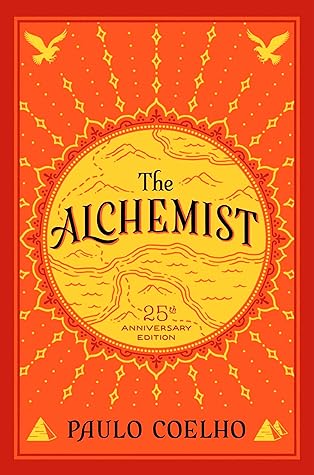
Paulo Coelho’s The Alchemist is a philosophical novel that explores the themes of destiny, personal legend, and the transformative journey of self-discovery. Originally written in Portuguese, the book has been translated into numerous languages and has sold millions of copies worldwide, earning it a place among the modern classics of literature.
Plot Summary:
The story follows Santiago, a young Andalusian shepherd who dreams of discovering a treasure located near the Egyptian pyramids. Guided by his recurring dreams and a mysterious figure known as Melchizedek, the King of Salem, Santiago decides to sell his flock and embark on a journey in search of his Personal Legend—a concept that signifies one’s true purpose in life.
Santiago’s journey is fraught with challenges and encounters that serve as allegorical lessons. In Tangier, he is robbed and forced to work for a crystal merchant, which teaches him about perseverance and the value of his dreams. He continues his journey through the Sahara Desert, where he meets an Englishman seeking the secrets of alchemy and a wise alchemist who imparts profound wisdom about listening to one’s heart and reading the omens along the way.
Santiago also falls in love with a woman named Fatima at an oasis, where he learns the importance of love and sacrifice in the pursuit of his dreams. The climax of the novel occurs when Santiago and the alchemist reach the pyramids, only for Santiago to discover that the true treasure lies not in gold or jewels but in the journey itself and the wisdom he has gained.
Themes:
- Personal Legend: Central to the novel is the idea that everyone has a Personal Legend, a true calling or purpose in life. Santiago’s journey is a metaphor for the pursuit of this personal destiny, emphasizing the importance of following one’s dreams despite obstacles.
- Alchemy and Transformation: Alchemy serves as a metaphor for personal transformation. Just as base metals can be turned into gold, Santiago’s experiences transform him, leading to spiritual and personal enlightenment.
- The Language of the World: Coelho introduces the concept of the “Language of the World,” a universal language understood by all living things. This mystical language is connected to the soul of the world and is accessible through intuition and the heart.
- Omens and Signs: Throughout the novel, Santiago learns to recognize and interpret omens and signs from the universe, suggesting that the world conspires to help those who pursue their Personal Legend.
- Love and Sacrifice: The novel explores the idea that true love does not hinder the pursuit of one’s dreams but rather supports and strengthens it. Santiago’s love for Fatima exemplifies this theme.
Literary Analysis:
Coelho’s prose is simple yet lyrical, making profound philosophical ideas accessible to a wide audience. The narrative is rich with symbolism and allegory, drawing from a variety of spiritual and philosophical traditions, including Christianity, Islam, and alchemy. The character of Santiago is an everyman figure, allowing readers to see their own journeys reflected in his.
The novel’s structure follows the classic hero’s journey, a narrative arc that resonates deeply with readers. Santiago’s external quest for treasure mirrors his internal quest for self-discovery, making The Alchemist both a compelling adventure story and a profound philosophical treatise.
Conclusion:
The Alchemist is a timeless tale that continues to inspire readers around the world to pursue their dreams and listen to their hearts. Its universal themes and allegorical style make it a rich text for literary analysis and personal reflection. Paulo Coelho’s masterful storytelling invites readers to embark on their own journeys of self-discovery and transformation, reminding us that the true treasures in life are often found within.
Discover more from The New Renaissance Mindset
Subscribe to get the latest posts sent to your email.
 The New Renaissance Mindset