
Overview
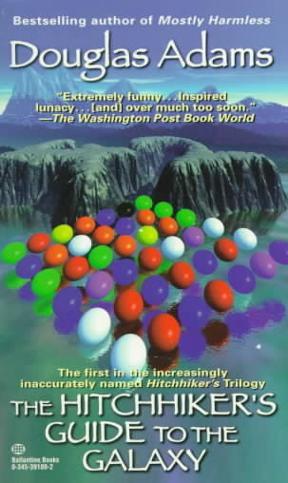
The Hitchhiker’s Guide to the Galaxy, written by Douglas Adams, is a seminal work in the science fiction genre. First published in 1979, it began as a radio series on BBC Radio 4 in 1978 before being adapted into a novel. The book has since become a cornerstone of modern science fiction and comedic literature, renowned for its wit, imagination, and satirical critique of human society.
Plot Summary
The novel begins with Arthur Dent, an ordinary Englishman, who finds his house about to be demolished to make way for a bypass. His friend Ford Prefect arrives with alarming news: the Earth itself is also about to be destroyed to make way for a hyperspace bypass. Ford, who turns out to be an alien researcher for a wholly remarkable book called The Hitchhiker’s Guide to the Galaxy, whisks Arthur away just before the planet is obliterated by the Vogons, a bureaucratic alien race.
The duo hitchhike aboard a Vogon spaceship, where they endure Vogon poetry before being thrown into space. They are improbably rescued by the Heart of Gold, a spaceship powered by the revolutionary Infinite Improbability Drive. The ship is piloted by Zaphod Beeblebrox, the two-headed, three-armed, ex-President of the Galaxy, along with his human companion Trillian (formerly Tricia McMillan) and Marvin, a depressed robot.
The journey continues with the group searching for the legendary planet of Magrathea, known for its luxury planet-building industry. Here, they meet Slartibartfast, a Magrathean who reveals that Earth was actually a supercomputer designed to find the Ultimate Question to Life, the Universe, and Everything. The Ultimate Answer, humorously revealed to be “42,” leaves everyone puzzled as to what the Ultimate Question actually is.
Themes and Analysis
The Hitchhiker’s Guide to the Galaxy is rich with themes that explore the absurdity of life, the randomness of existence, and the folly of human bureaucracy. Adams uses his unique brand of humor to highlight the triviality of human concerns in the vastness of the universe. The novel pokes fun at the human tendency to seek meaning in an indifferent cosmos, often finding solace in arbitrary answers.
One of the central themes is the unpredictability and chaos inherent in the universe. The Infinite Improbability Drive symbolizes this randomness, creating bizarre and unexpected situations. The destruction of Earth for a galactic bypass reflects the impersonal and often nonsensical nature of bureaucratic decisions, mirroring real-world frustrations with red tape and governmental inefficiency.
The character of Marvin, the perpetually depressed robot, serves as a satirical commentary on the potential downside of artificial intelligence and the paradox of creating machines with human-like emotions. His gloom contrasts sharply with the often frivolous and absurd happenings around him, emphasizing the theme of existential despair.
Style and Tone
Douglas Adams’ writing style is distinctive, marked by its clever wordplay, dry wit, and philosophical musings. The tone of the novel is consistently humorous, blending elements of satire and absurdity to create a light-hearted yet thought-provoking narrative. Adams’ prose is filled with memorable quotes and imaginative descriptions, making the book a delight to read for fans of both science fiction and comedy.
Reception and Legacy
Since its publication, The Hitchhiker’s Guide to the Galaxy has achieved cult status, spawning a series of sequels, adaptations in various media, and a dedicated fan base. It has been praised for its originality, creativity, and enduring humor. The book has influenced numerous writers and comedians, establishing Douglas Adams as a significant figure in contemporary literature.
Conclusion
The Hitchhiker’s Guide to the Galaxy is a masterful blend of science fiction and comedy, offering readers a whimsical yet profound exploration of life’s big questions through the lens of intergalactic travel and cosmic absurdity. Douglas Adams’ novel remains a timeless classic, celebrated for its inventive storytelling, sharp wit, and enduring appeal.
Discover more from The New Renaissance Mindset
Subscribe to get the latest posts sent to your email.
 The New Renaissance Mindset