
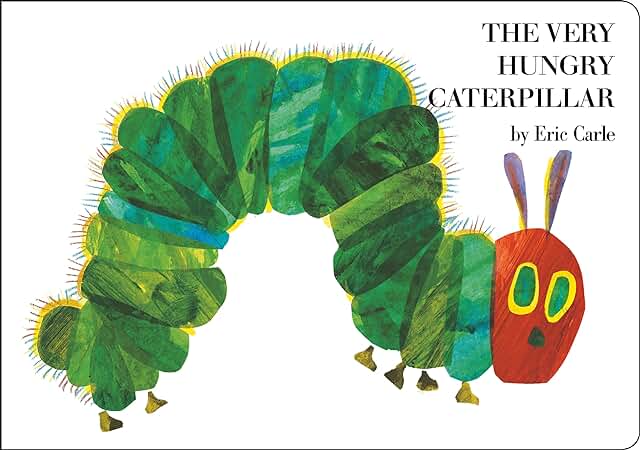
Eric Carle’s The Very Hungry Caterpillar is a timeless classic in children’s literature, celebrated not only for its charming simplicity but also for its rich thematic depth and innovative design. Published in 1969, the book has captured the imaginations of readers across generations, making it a staple in early childhood education. The story’s blend of visual art, narrative, and educational content creates an engaging experience for young readers, while also offering layers of meaning that can be appreciated by adults.
Plot Summary
The story follows the journey of a tiny caterpillar that emerges from an egg and immediately embarks on an extraordinary eating spree. From Monday to Sunday, the caterpillar devours an increasing quantity of food, ranging from fruits to sweets. Each day, he eats more, reflecting the days of the week, until he finally becomes “a big, fat caterpillar.” After indulging in a variety of foods, he experiences a stomachache and wisely decides to eat a leaf, which helps him feel better. Eventually, he forms a cocoon around himself, and after two weeks, he emerges as a beautiful butterfly, completing his metamorphosis.
Themes and Analysis
The Very Hungry Caterpillar is often lauded for its educational value, teaching children about the life cycle of a butterfly, counting, days of the week, and the concept of growth and change. However, the book also subtly explores deeper themes that resonate with readers of all ages.
- Growth and Transformation: At its core, the book is a tale of metamorphosis, a natural process that serves as a powerful metaphor for personal growth and change. The caterpillar’s journey from a small, ravenous creature to a magnificent butterfly symbolizes the potential for transformation within all living beings. This theme is especially poignant for young children, who are themselves in the process of rapid growth and development.
- Moderation and Consequences: The caterpillar’s overindulgence in various foods and the subsequent stomachache highlight the importance of moderation and the consequences of excess. This aspect of the story serves as an early lesson in self-regulation, a concept that children are beginning to understand as they navigate their own impulses and desires.
- Cycles and Continuity: The book’s structure, which is organized around the days of the week, emphasizes the cyclical nature of time and life. The caterpillar’s metamorphosis is not just a one-time event but part of a larger, continuous cycle of life that includes birth, growth, and renewal. This cyclical theme is subtly reinforced through the repetitive language and the predictable pattern of the narrative.
Illustration and Design
Eric Carle’s distinctive collage illustrations are as significant as the narrative itself. The vibrant, textured artwork, created with hand-painted papers, gives the story a tactile quality that enhances its appeal. The holes in the pages, corresponding to the foods the caterpillar eats, engage children in a physical way, inviting them to interact with the book. This innovative design not only makes the book more interactive but also reinforces the idea of the caterpillar’s insatiable appetite.
The use of color in the illustrations also plays a critical role in conveying the story’s themes. The bright, vivid colors reflect the vitality and energy of the caterpillar’s journey, while the transition from the small, simple images at the beginning to the large, elaborate butterfly at the end visually represents the process of growth and change.
Conclusion
The Very Hungry Caterpillar is a masterpiece of children’s literature, combining simple yet profound storytelling with innovative design and beautiful illustrations. Its universal themes of growth, change, and the passage of time resonate with readers of all ages, making it a book that can be appreciated on multiple levels. Whether read as an educational tool, a metaphor for transformation, or simply as a delightful story, Eric Carle’s work continues to enchant and inspire, securing its place as a beloved classic.
Discover more from The New Renaissance Mindset
Subscribe to get the latest posts sent to your email.
 The New Renaissance Mindset