
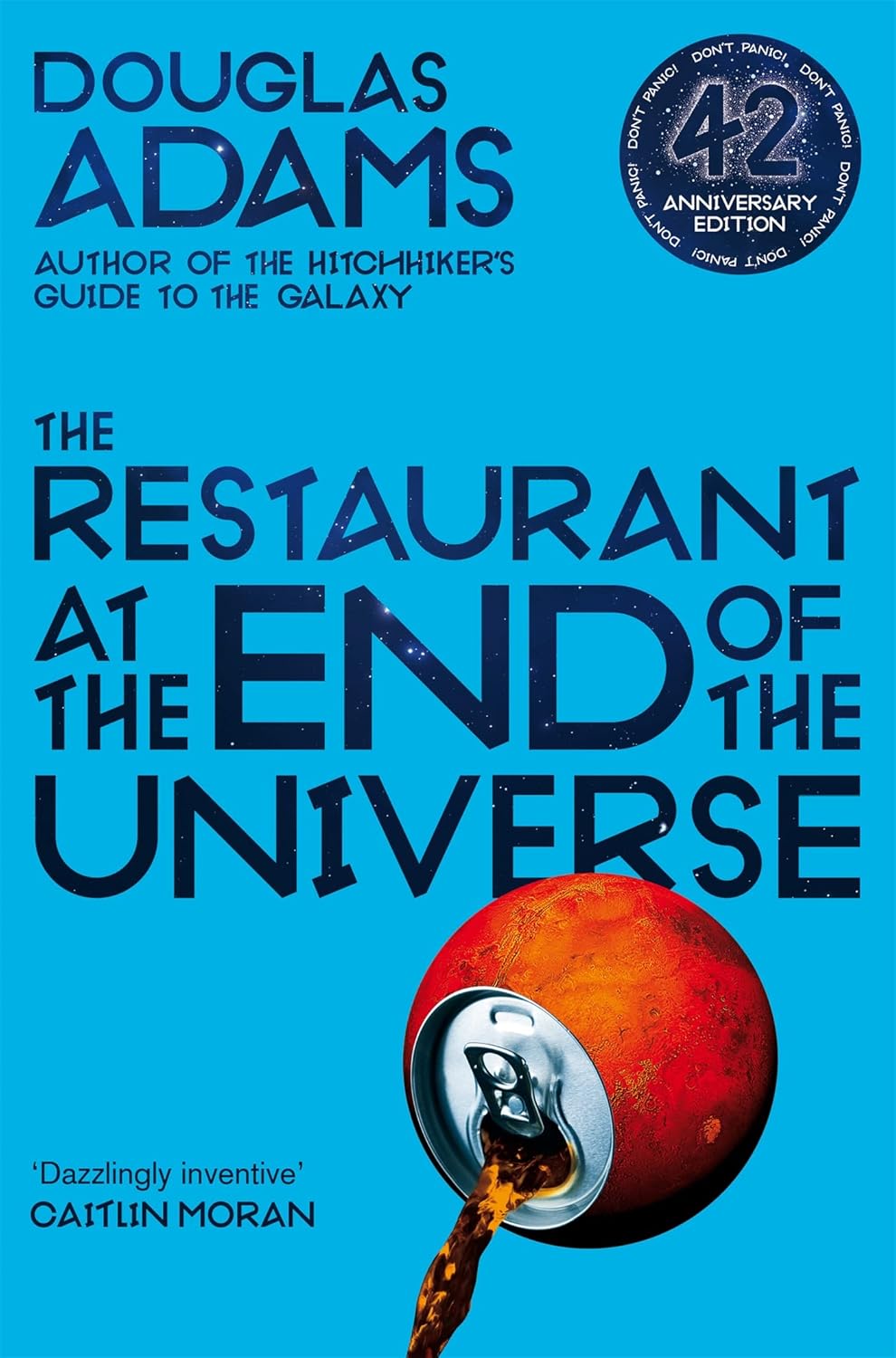
Douglas Adams’ The Restaurant at the End of the Universe is a tour de force of absurdist wit, existential philosophy, and satirical brilliance. As the second instalment in the Hitchhiker’s Guide to the Galaxy series, it expands the galactic lunacy established in its predecessor, offering readers a richly textured narrative that defies genre conventions while inviting profound contemplation.
A Symphony of Chaos
The novel opens with a premise emblematic of Adams’ knack for comedic escalation: Zaphod Beeblebrox, the two-headed, self-absorbed former President of the Galaxy, faces an assassination attempt while grappling with his own muddled past. Meanwhile, Arthur Dent, the hapless Earthman, simply wants a decent cup of tea—an endearingly mundane desire amidst the cosmic absurdity. This juxtaposition of the ordinary and the extraordinary is one of Adams’ most potent tools, emphasizing the absurdity of existence while grounding his narrative in relatable human desires.
Adams constructs the titular restaurant as both a literal and metaphorical endpoint. Situated at the temporal edge of the universe, it is a place where diners witness the apocalypse as entertainment—a pointed critique of consumerism and humanity’s tendency to trivialize existential crises. This setting encapsulates Adams’ ability to weave comedy with incisive social commentary, using humor as a lens to examine the absurdities of human priorities.
Characters as Archetypes and Counterpoints
The novel’s characters function not only as participants in the narrative but also as reflections of philosophical and societal archetypes. Zaphod’s self-indulgent bravado contrasts with Arthur’s bewildered stoicism, highlighting humanity’s oscillation between hubris and humility. Ford Prefect and Trillian, meanwhile, act as intermediaries—observing and navigating the chaos with a pragmatic detachment that underscores the novel’s underlying message: survival often requires a keen understanding of the absurd.
The character of Marvin the Paranoid Android deserves special mention. His sardonic melancholy and hyper-intelligent despair offer a counterpoint to the novel’s frenetic energy. Marvin’s existential malaise is both humorous and poignant, serving as a reminder of the often-overlooked emotional cost of intelligence and awareness.
Thematic Resonance
Adams excels at embedding profound questions within his whimsical narrative. What does it mean to exist in a universe governed by randomness? How does one find meaning in an inherently meaningless cosmos? These questions permeate the text, disguised by absurdist humor but no less impactful. For instance, the absurdity of the Total Perspective Vortex—a machine designed to show an individual their insignificance in the universe—becomes a sharp critique of existential dread and humanity’s quest for self-importance.
The book also explores the interplay between fate and free will. Zaphod’s journey through improbability fields and predestined revelations questions the extent of autonomy in a universe driven by chaotic improbabilities. Yet, Adams’ refusal to offer definitive answers reinforces the novel’s thematic core: ambiguity and uncertainty are the only constants.
Style and Legacy
Adams’ prose is marked by a unique cadence that blends erudite wordplay, deadpan delivery, and imaginative descriptions. His ability to shift from the microscopic (Arthur’s quest for tea) to the macroscopic (the universe’s demise) within a single paragraph exemplifies his literary dexterity. The book’s humor—whether rooted in linguistic cleverness or situational irony—invites readers to revel in its absurdity while reflecting on the deeper implications of its narrative.
The Restaurant at the End of the Universe is not merely a sequel; it is a continuation of Adams’ philosophical exploration through comedy. Its enduring legacy lies in its ability to entertain while challenging readers to confront the absurdities of their own lives. By laughing at the universe’s chaos, Adams suggests, we might just learn to embrace it.
As a work of speculative fiction, The Restaurant at the End of the Universe transcends its genre, functioning as both a comedic escapade and a meditation on the human condition. It is a masterpiece of absurdist literature, offering insights into the profound and the trivial with equal aplomb. Douglas Adams reminds us that, in the grand scheme of things, the universe may be indifferent—but that doesn’t mean we can’t enjoy the ride.
Discover more from The New Renaissance Mindset
Subscribe to get the latest posts sent to your email.
 The New Renaissance Mindset