
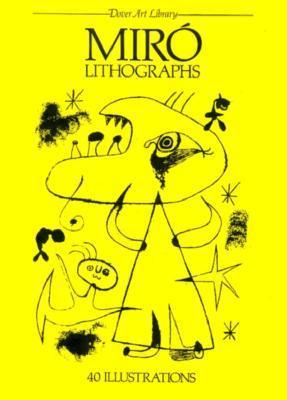
Joan Miró’s visual lexicon—a mesmerizing blend of surreal abstraction and childlike spontaneity—finds a fitting canvas in Miró Lithographs: 40 Illustrations, a volume that distills the artist’s lithographic works into an accessible, yet deeply evocative, format. Published by Dover Publications, this collection transcends mere documentation, serving as a bridge between Miró’s enigmatic inner world and the reader’s imaginative engagement.
At its core, this book captures the essential paradox of Miró’s artistry: the simultaneous simplicity and complexity of his imagery. The 40 lithographs chosen for this volume represent a curated journey through his signature style, with bold forms and primary colors intersecting in ways that defy conventional composition. Each piece becomes a microcosm of Miró’s recurring themes—cosmic symbolism, organic forms, and a surrealist’s flirtation with the subconscious. Dover’s meticulous reproduction allows readers to appreciate the nuanced textures and vibrant hues that are central to lithography as a medium.
The book’s compact size and affordability reflect Dover’s mission to democratize art, but this accessibility does not diminish the academic and artistic depth of the collection. Miró’s lithographs, though rendered in this pared-down format, retain their hypnotic allure. Each image invites viewers to linger, to decode the mysterious interplay of shapes and lines, and to marvel at the artist’s ability to transform seemingly spontaneous gestures into deeply resonant visual poetry.
From a scholarly perspective, the selection of works offers insight into Miró’s evolving artistic philosophy. His lithographs reveal a tension between control and freedom—an aesthetic that oscillates between structure and whimsy, form and emptiness. This duality aligns with the broader context of 20th-century modernism, where artists sought to challenge traditional paradigms and explore the subconscious as a source of creativity.
One of the book’s most compelling aspects is its potential as a pedagogical tool. Educators and students of art alike will find value in Miró’s lithographs as an entry point for discussions on abstraction, surrealism, and the possibilities of printmaking. The relative simplicity of Miró’s forms belies their layered meanings, making them ideal for fostering critical interpretation and creative exploration.
However, the book is not without its limitations. While the reproductions are high-quality, the absence of critical essays or contextual commentary leaves the reader to navigate Miró’s visual universe without a guide. For seasoned scholars, this may be an opportunity to focus purely on the art, but for readers unfamiliar with Miró or the medium of lithography, the lack of interpretative framing could hinder a deeper appreciation of his work’s cultural and artistic significance.
Miró Lithographs: 40 Illustrations is a compact treasure trove that celebrates the essence of Joan Miró’s vision. While its simplicity may not fully satisfy those seeking exhaustive analysis, it excels in presenting Miró’s lithographic mastery in an approachable format. Whether viewed as a source of aesthetic inspiration or a springboard for intellectual inquiry, this volume affirms Miró’s enduring ability to captivate and provoke, reminding us of the power of art to evoke both wonder and introspection.
Discover more from The New Renaissance Mindset
Subscribe to get the latest posts sent to your email.
 The New Renaissance Mindset