
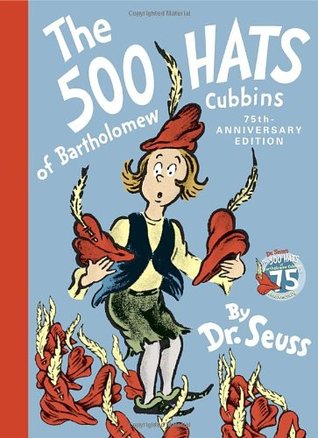
The 500 Hats of Bartholomew Cubbins by Dr. Seuss, originally published in 1938, represents a fascinating entry in the author’s canon, offering more than the whimsical adventure for which he is well known. In this tale, Seuss explores themes of identity, power, and conformity, woven into a narrative that is as visually engaging as it is philosophically profound.
At its core, the book follows the eponymous Bartholomew Cubbins, a young boy who, while trying to rid himself of one particularly stubborn hat, is forced into a series of increasingly absurd and fantastical situations. Each time he removes a hat, another appears in its place, eventually culminating in a comically excessive 500 hats. While the narrative’s fantastical nature invites a playful reading, it is clear that Seuss, ever the social critic, uses this whimsical device to delve into a deeper reflection on the forces that drive us toward conformity and the external pressures that shape our identities.
One of the most compelling aspects of The 500 Hats is the way Seuss highlights the tension between individual agency and societal expectation. Bartholomew’s unrelenting quest to remove his hats parallels the human struggle to shed societal norms, to assert individuality in the face of conformity. The hats themselves, an outward symbol of status or expectation, mirror the burdens of identity that are thrust upon individuals, with each successive hat serving as a metaphor for the increasing complexity of self-perception in a world governed by rules, appearances, and power dynamics.
The narrative also hints at the absurdity of hierarchical systems. The king, who demands Bartholomew remove his hats, stands as a figure of authority that holds arbitrary power over the boy. This scene can be interpreted as a satire of authoritarian figures who impose their will on the individual, demanding obedience to rules that are both illogical and, in many ways, unnecessary. It is only when Bartholomew challenges this system—by remaining unshaken in his persistence—that the oppressive structure collapses, and the true nature of the “problem” is revealed. This is perhaps Seuss’s most subversive message: the moment we acknowledge the absurdity of the external pressures we face, they lose their power.
Visually, the book is a feast for the eyes, as Seuss’s characteristic style of bold, curving lines and energetic patterns enhances the humor and underlying critique of the text. The exaggerated nature of Bartholomew’s hats grows in scale and complexity, mirroring the escalating tensions between the individual and society. Each hat, though playful in design, carries a sense of weight and seriousness that imbues the story with layers of meaning.
The 500 Hats of Bartholomew Cubbins stands as a brilliant exploration of individuality, power, and the absurdity of social conventions, all wrapped in the playful, delightful language and art that Seuss is known for. Beneath the surface of this children’s story lies a sharp critique of conformity, making it a timeless work that invites readers of all ages to reflect on the hats they wear—both literal and figurative—and the societal forces that shape them.
Discover more from The New Renaissance Mindset
Subscribe to get the latest posts sent to your email.
 The New Renaissance Mindset