
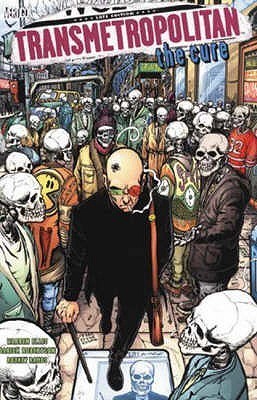
Transmetropolitan, Vol. 9: The Cure, penned by Warren Ellis and illustrated by Darick Robertson, represents a pivotal moment in the evolution of both its protagonist, Spider Jerusalem, and the dystopian world he inhabits. As with the earlier volumes, Ellis crafts a narrative that is as intellectually stimulating as it is viscerally brutal. In this volume, the series continues its unflinching examination of power, media, and the human condition, all while maintaining its trademark frenetic pace and biting humor.
The overarching theme of The Cure is one of confronting personal and societal decay. Spider Jerusalem, the antihero journalist with a penchant for self-destruction and razor-sharp commentary, finds himself facing not just external corruption but an internal collapse of sorts. He’s an embittered observer, but the demands of the world—ever more chaotic and out of control—have taken their toll. In this volume, the idea of “the cure” is introduced as both a literal and metaphorical solution to this decay. Spider, seeking a remedy for both his fractured body and soul, confronts the moral and existential implications of this cure, which seems to promise a reprieve from the alienating world around him.
Ellis’s writing, as ever, is characterized by its satirical edge and dark wit, which sharpens the social critique that lies at the heart of the work. In The Cure, Ellis extends his commentary on the commodification of truth, the dehumanizing aspects of technology, and the pervasive surveillance state, all wrapped in the searing chaos of a corrupt, disintegrating society. Ellis’s dialogue, especially Spider’s internal monologue, resonates with an almost prophetic insight into the state of media and politics. It becomes increasingly clear that Spider’s crusade is not just for truth in journalism, but for the preservation of human agency within a world that seems intent on stripping it away.
Robertson’s art is as essential to The Cure as Ellis’s script. The stark, visceral quality of the artwork complements the dark themes of the narrative. Robertson’s use of grotesque detail in the depiction of both the human form and the cityscape emphasizes the corruption, excess, and existential despair that pervades Transmetropolitan. His expressive rendering of Spider’s increasingly deteriorating physicality—a visual metaphor for his inner turmoil—adds an additional layer of emotional weight to the narrative. The contrast between the ultra-modern technological backdrop and the crumbling humanist ideals forms a central tension within the volume, and Robertson’s artwork effectively brings this conflict to the forefront.
The volume’s pacing is relentless, much like the world Spider inhabits. Each page feels like a wave crashing against the reader’s sensibilities, dragging them through a whirlwind of philosophical inquiry and dark humor. Yet, beneath the barrage of shock and spectacle, there is a deeply human struggle—Spider’s search for meaning in an increasingly mechanized world. He is, at his core, a tragic figure, a man who clings to the hope of a cure, not just for his physical ailments but for the larger world’s moral sickness. The volume asks whether such a cure is even possible or whether we are all bound to become the very thing we seek to overcome.
In terms of character development, The Cure marks a subtle, yet significant, shift in Spider’s arc. While he remains as acerbic and disillusioned as ever, this volume introduces moments of vulnerability, which complicate his image as the perennial outsider. His journey is both a literal and metaphorical descent, a descent that confronts not just his own personal demons but also the larger questions of the human condition. Spider may be a broken man, but he is also a voice of unvarnished truth in a world that seems to value spectacle over substance.
Transmetropolitan, Vol. 9: The Cure continues to exemplify the best qualities of Ellis’s work: an unyielding critique of modern society, a complex and morally ambiguous protagonist, and a darkly satirical worldview. The volume is an essential read for fans of the series, but it also stands as a powerful testament to the ability of graphic novels to address existential themes and ask hard-hitting questions about the future of humanity. Ultimately, The Cure offers no simple answers but leaves readers contemplating the possibility of redemption, both for Spider and for the world he inhabits.
Discover more from The New Renaissance Mindset
Subscribe to get the latest posts sent to your email.
 The New Renaissance Mindset