
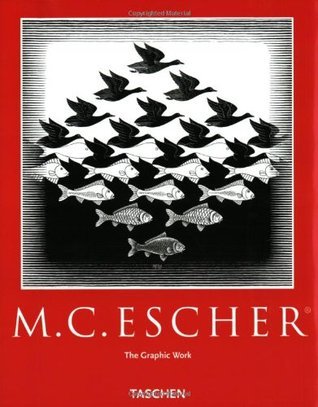
Mathematical Imagination and the Art of the Impossible
Few artists command a space so firmly between the rational and the surreal as Maurits Cornelis Escher. M.C. Escher: The Graphic Work is both a testament to his singular vision and an invitation into a world where reality folds upon itself in recursive patterns, and logic succumbs to paradox. This collection of his most celebrated prints serves as more than an artistic retrospective—it is a philosophical text rendered in lithograph and woodcut, a visual meditation on infinity, symmetry, and perception.
Form as Thought, Thought as Form
Escher’s work is an exercise in both mathematical precision and aesthetic wonder, a convergence of disciplines that traditionally stand apart. With the eye of a printmaker and the mind of a geometer, Escher orchestrates tessellations, Möbius loops, and impossible architectures that challenge the viewer’s cognitive faculties. Each image in this collection—be it Ascending and Descending, Relativity, or Metamorphosis—is not merely a representation but an interrogation: How does one define boundaries when up and down are interchangeable? When negative space reveals as much as positive? When transformation and continuity deny the finality of form?
By sequencing Escher’s work chronologically and thematically, The Graphic Work allows the reader to witness the evolution of his technical prowess. The early woodcuts show his fascination with naturalistic landscapes, while his later prints delve into more complex, recursive structures. His development mirrors a deepening philosophical inquiry—moving from the observation of external reality to the construction of internal logic systems.
Escher and the Metaphysics of Space
Though Escher often distanced himself from formal mathematical study, his work resonates with deep mathematical principles—tiling theory, topology, hyperbolic geometry. His drawings of infinite staircases and warped perspectives anticipate the visual language of modern physics, particularly in their evocation of non-Euclidean space. In Hand with Reflecting Sphere, Escher places himself at the center of an optical illusion, underscoring the instability of perspective and the subjectivity of observation. This engagement with perception places him in conversation with philosophical traditions extending from Plato’s cave allegory to phenomenology’s concern with how we construct reality.
Yet, despite this rigorous intellectualism, Escher never loses sight of the poetic. His prints contain humor, whimsy, and even existential dread. The figures in Belvedere peer helplessly at a world that refuses to adhere to their spatial logic; the creatures in Reptiles perpetually emerge from and return to the page, caught in an endless cycle of becoming. His images are both beautiful and unsettling, comforting in their order yet unnerving in their implications.
The Lasting Impact of Escher’s Vision
M.C. Escher: The Graphic Work is not just an art book—it is a challenge to the way we see. Escher forces us to confront the limitations of our perception, to question whether reality itself might be another one of his elaborate illusions. His art has found admirers in mathematicians, philosophers, and artists alike, influencing everything from theoretical physics to modern architecture and even pop culture.
Escher’s genius lies in his ability to make the impossible appear inevitable. His constructions do not demand mere suspension of disbelief; they insist on reconfiguring belief itself. This collection, then, is more than a book of prints—it is an artifact of intellectual wonder, a bridge between the artistic and the analytical, and a lasting proof that art, at its most profound, does not merely depict reality but transforms it.
Discover more from The New Renaissance Mindset
Subscribe to get the latest posts sent to your email.
 The New Renaissance Mindset