
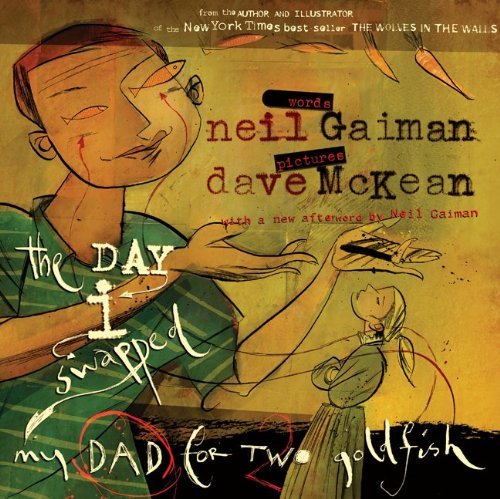
Neil Gaiman’s The Day I Swapped My Dad for Two Goldfish stands as a succinct yet evocative exploration of childhood’s capacity to reinterpret and revalue the world around it. With a narrative that at first blush appears absurd, Gaiman employs a playful economy of language and imagery to invite readers into a subversive fable where familial bonds are both literal and metaphorical commodities.
Interrogating Value and Authority:
At its core, the text deconstructs conventional hierarchies within the family structure. The protagonist’s decision to trade his father for goldfish is emblematic of a child’s nascent understanding of worth—where the value of a parent is not measured in affection or duty, but in the tangible exchange of prized objects. This inversion not only challenges adult authority but also subverts the social contract inherent in familial relationships, prompting readers to question the criteria by which we assign value in both personal and societal spheres.
Stylistic Minimalism and Whimsical Surrealism:
Gaiman’s stylistic approach is deceptively simple. His prose mirrors the unadulterated logic of youth—a logic that is at once charming and disquieting. The narrative’s sparse, deliberate rhythm, interwoven with bursts of surreal humor, mirrors the child’s fluid world of imagination. This minimalism allows the narrative’s subtext to flourish: the absurdity of the swap becomes a vehicle through which deeper themes of loss, desire, and transformation are subtly interrogated.
Myth and Modernity:
While firmly rooted in the tradition of modern children’s literature, the text also echoes the archetypal quality of ancient fables. Gaiman’s ability to merge mythic structures with the banal realities of modern life situates the story within a broader literary dialogue—one that speaks to the timeless interplay between innocence and the often inscrutable logic of adulthood. The goldfish, ephemeral and elusive, stand as potent symbols of the transient nature of desire and the mutable boundaries of identity.
A Multiplicity of Interpretations:
Critically, the book rewards both a literal reading and a more nuanced, allegorical analysis. On one level, it is a humorous tale designed to amuse; on another, it is a commentary on the complexities of human relationships and the dissonance between appearance and essence. The narrative’s brevity ensures that each line carries weight, demanding that the reader engage actively with its layered meanings.
The Day I Swapped My Dad for Two Goldfish is more than a mere children’s tale—it is a text that encapsulates the imaginative potential of literature to unsettle and redefine normative values. Gaiman’s work continues to resonate, offering a playful yet piercing critique of the ways in which we navigate the emotional economies of our lives.
Discover more from The New Renaissance Mindset
Subscribe to get the latest posts sent to your email.
 The New Renaissance Mindset