
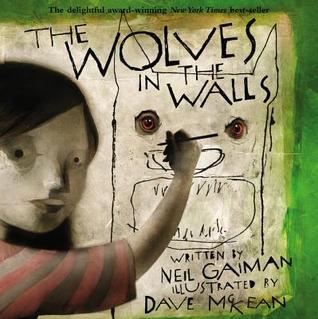
Neil Gaiman’s The Wolves in the Walls stands as a singular achievement in children’s literature—a text that oscillates between the realms of playful fantasy and unsettling dread. In this picture book, Gaiman expertly harnesses the power of narrative ambiguity to provoke a deeper meditation on the boundaries between the safe confines of the domestic sphere and the wild, untamed spaces lurking just beyond its walls.
Narrative and Structural Innovation
At its core, the story is deceptively simple: the family’s home is invaded by mysterious, noise-making wolves that dwell in its very walls. Yet, this simplicity is precisely where Gaiman’s genius resides. He employs an economy of language, engaging illustrations, and a narrative rhythm that mirrors both the security of home and the palpable threat of the unknown. The story’s cyclical structure—alternating between moments of comic levity and stark tension—invites readers to reconsider the reliability of appearances and the nature of the fears we harbor. This juxtaposition is particularly resonant in the context of children’s literature, where the interplay of fear and humor can serve as a conduit for broader existential questions.
Thematic Depth and Symbolism
The wolves themselves are emblematic, representing the latent, often unspoken anxieties that dwell within every seemingly secure space. Their intrusion is not merely a physical disruption but a metaphor for the inevitable encounter with chaos that lies beneath the veneer of order. Gaiman subtly challenges the conventional dichotomy between safety and danger, suggesting that the two are inextricably intertwined. In doing so, he allows both children and adults to confront the idea that even the most familiar settings can conceal untamed, unpredictable elements.
Moreover, the narrative’s treatment of the domestic space as both a sanctuary and a potential site of invasion encourages a reading that transcends age. It becomes a meditation on how we construct and deconstruct our perceptions of safety, and how the unknown can sometimes be both a source of creativity and anxiety.
Illustrative Synergy and Visual Metaphor
The collaboration between text and illustration in The Wolves in the Walls is a masterclass in visual storytelling. The artwork does not simply complement the narrative—it amplifies it. The whimsical yet eerie depictions of the wolves create a tangible sense of intrusion, blending the playful with the ominous. This interplay encourages a dual reading: on one level, it is a delightful romp through an enchanted household; on another, it is a reminder of the inherent instability of our constructed realities.
Cultural and Literary Impact
In the broader context of Gaiman’s oeuvre, this work resonates with his characteristic blending of myth, horror, and humor. It reflects his ability to appeal to both children and adults, inviting a multilayered interpretation that enriches the reading experience with every revisit. The Wolves in the Walls stands as an exemplary work within the children’s genre—not merely for its inventive narrative and striking visuals, but for its capacity to engage with themes of fear, transformation, and the persistence of wonder.
Reflections
Ultimately, The Wolves in the Walls is more than a children’s book—it is a literary artifact that challenges its readers to confront the dualities of safety and danger, order and chaos. Through a deft blend of narrative ingenuity and illustrative prowess, Gaiman offers a text that is as intellectually stimulating as it is visually enchanting. For the literary scholar, it presents a rich text for analysis; for the casual reader, it provides a compelling, multi-layered story that lingers long after the final page is turned.
Discover more from The New Renaissance Mindset
Subscribe to get the latest posts sent to your email.
 The New Renaissance Mindset