
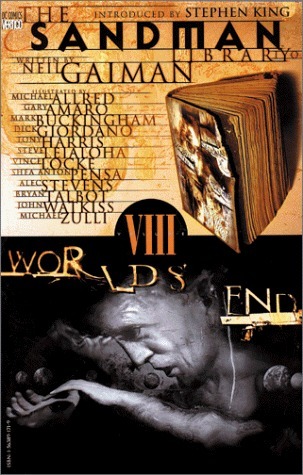
Neil Gaiman’s The Sandman, Vol. 8: Worlds’ End stands as a masterful convergence of myth, storytelling, and visual art that invites both readers and scholars into an intricate labyrinth of narrative and symbolism. This volume, perhaps more than any other in the series, exemplifies how the medium of graphic novels can transcend mere sequential art to become a profound commentary on the nature of stories themselves.
A Tapestry of Narratives
At its core, Worlds’ End is a meta-narrative—a collection of interwoven tales told by a motley crew of characters seeking refuge at a waystation for lost souls and transient travelers. Gaiman employs the narrative technique of framing stories within a story, reminiscent of the medieval “frame tale” tradition. Each anecdote, myth, and whispered legend that unfolds around the inn acts as both a narrative in its own right and a reflective mirror on the act of storytelling. In doing so, Gaiman hints at the ephemeral nature of all storytelling: the idea that stories, like dreams, are fleeting yet potent reservoirs of collective memory and human experience.
Themes of Time, Memory, and the Ephemeral
A recurring theme throughout Worlds’ End is the interplay between time and memory. Gaiman disrupts the traditional linear experience of narrative by treating time as fluid—much like the dreams that inhabit the larger Sandman mythos. The travelers’ tales, each steeped in bittersweet nostalgia, explore the tension between personal memory and the inexorable march of time. This motif is further underscored by the surreal shifts in narrative perspective that challenge readers to reconcile the tangible with the abstract. The inn, serving as a transient haven, becomes a metaphor for the liminal space between reality and the stories we tell to make sense of our existence.
Visual Storytelling and Artistic Flourish
Artistically, Worlds’ End is a feast of innovation and homage. The diverse artistic contributions reflect the polyphonic nature of the narrative itself. Varied illustrative styles—from delicate, almost dreamlike watercolor hues to the stark contrasts of heavy ink—mirror the multifaceted textures of the stories being recounted. These visual styles do more than complement the text; they serve to immerse readers in a world where the ordinary dissolves into the mythic. The art encourages an active engagement with the narrative, asking the reader to navigate symbolic landscapes that are as emotionally resonant as they are visually arresting.
The Role of the Inn as a Liminal Space
The setting of the inn in Worlds’ End is pivotal. Far from being a mere backdrop, the inn is a liminal space—a nexus where disparate realities and divergent time streams converge. This element of the narrative reinforces Gaiman’s preoccupation with the concept of thresholds—the fragile borders between waking and sleeping, past and future, myth and history. The inn, populated by travelers from various epochs and realms, becomes a microcosm for the entirety of the human condition, serving as a repository for all manner of collective human experience, fraught with longing, loss, and hope.
Intertextuality and the Scholarly Conversation
Gaiman’s intertextual approach is undeniable. By drawing upon a rich pantheon of folklore, legend, and literary tradition, Worlds’ End functions as both a dialogue with the past and a commentary on the act of myth-making itself. The text is rife with references to classical literature, historical epics, and even the language of modern pop culture. This blending of the erudite and the accessible ensures that the volume resonates on multiple levels: it is at once a critical commentary on literary tradition and a vivid, immersive narrative experience in its own right.
In The Sandman, Vol. 8: Worlds’ End, Neil Gaiman has crafted a work that is as intellectually stimulating as it is visually compelling. The volume defies easy categorization, intertwining the strands of myth, memory, and dream in a way that both challenges and rewards its readers. For the literary scholar, it offers fertile ground for exploration—themes of temporality, the nature of narrative, and the role of art in capturing the fleeting nature of human experience come together in a narrative that is as layered and enigmatic as the inn where these myriad tales converge.
Ultimately, Worlds’ End stands as a testament to the transformative power of storytelling—a reminder that every narrative, no matter how ephemeral, is imbued with the potential to transport, transform, and transcend the boundaries of time and space.
Discover more from The New Renaissance Mindset
Subscribe to get the latest posts sent to your email.
 The New Renaissance Mindset