
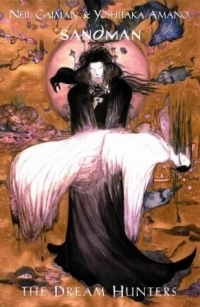
Neil Gaiman’s The Sandman: The Dream Hunters stands at the crossroads of myth, folklore, and narrative innovation, inviting its readers into a liminal realm where the boundaries between waking reality and the ineffable landscape of dreams blur with captivating ambiguity.
A Convergence of Myths and Modern Storytelling
At its core, the novella reimagines the timeless struggle between the tangible and the ephemeral by meshing traditional folklore with the distinctive narrative framework of the Sandman universe. Gaiman masterfully interweaves elements of Japanese mythology with the Western archetypal narrative of the hero’s journey, transforming a simple tale of dream and pursuit into a multifaceted exploration of the human psyche. The narrative delicately balances mysticism and melancholia, offering a rich tapestry that lingers in the minds of its readers long after the final page is turned.
The Poetics of the Dreamscape
Gaiman’s prose in The Dream Hunters is both lyrical and laden with a dreamlike quality that mirrors the transient nature of dreams themselves. His language is, at times, deliberately elliptical—evoking the elusive nature of memories and desires—while at other moments, it is stark and unadorned, granting the narrative an air of authenticity. This oscillation in style enhances the thematic exploration of duality and transformation: the interplay between the conscious and the subconscious, the seen and the unseen. The work is a meditation on the power of dreams to shape our understanding of self and time, and Gaiman’s words resonate with the cadence of a poetic incantation.
Subversion and Reinterpretation of Genre
One of the most compelling aspects of The Dream Hunters is its subversion of the expectations traditionally associated with horror and fantasy. While the narrative contains the eerie, unsettling overtones characteristic of horror literature, it simultaneously offers a redemptive quality—the idea that beauty and enlightenment can emerge from the darkness. Gaiman’s characters, particularly the enigmatic Dream and the courageous seeker who defies the veil of the mystical, are emblematic of a broader narrative ambition: to reveal that the pursuit of understanding—even when it delves into the terrifying corners of the unknown—can ultimately lead to an elevated sense of wonder and insight.
Visual and Symbolic Resonance
The work is also notable for its symbiotic relationship with the visual elements that have become synonymous with the broader Sandman oeuvre. Gaiman’s narrative is not merely a story to be read but an experience to be seen. The imagery, whether rendered explicitly in illustrations or evoked through the reader’s imagination, functions as a bridge between the literal and the figurative. It provides a visual lexicon that transcends language—a language of symbols, shadows, and the ethereal that invites interpretation as much as it narrates. Here, every dream is a canvas, every shadow a potential allegory of the subconscious.
Intertextual Reflections and Cultural Impact
In literary tradition, The Dream Hunters resonates with texts that explore the enigmatic and the ineffable. It echoes the allegorical qualities of Milton’s epic visions while drawing on the modernist experimentation of authors like Jorge Luis Borges, who similarly challenged conventional narrative forms. Moreover, Gaiman’s work is in dialogue with ancient myths and legends, revitalizing them with contemporary sensibilities and existential questions. The result is a narrative that not only honors its mythological antecedents but also redefines them for the modern reader, bridging the gap between ancient wisdom and modern existential dilemmas.
The Sandman: The Dream Hunters is an exemplary text for those who seek literature that transcends the boundaries of genre. Neil Gaiman’s sophisticated interplay of myth, philosophy, and poetic narrative makes the novella a rich subject for scholarly inquiry. It is as much an exploration of the human condition—its hopes, its fears, and its perpetual transformation—as it is a journey through an otherworldly landscape where the ultimate truth is whispered in dreams. The enduring appeal of this work lies in its ability to challenge readers to question the nature of reality and to appreciate the profound beauty that lies in the spaces between waking life and the dreams that guide us.
Discover more from The New Renaissance Mindset
Subscribe to get the latest posts sent to your email.
 The New Renaissance Mindset