
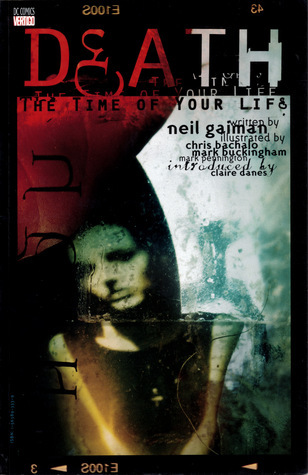
Neil Gaiman’s Death: The Time of Your Life offers a remarkable subversion of traditional personifications of death, recasting an archetype feared and mythologized through centuries as a compassionate, even vivacious, entity. The work stands as a compelling exploration of mortality through the prisms of identity, love, and transformation, inviting readers to interrogate the fine line between life’s frailty and its inherent beauty.
Reimagining an Archetype
Gaiman transforms Death from a spectral, inevitable force into a character of startling humanity—a punk-rock redefinition of an age-old myth. This incarnation of Death is not a faceless, omnipotent presence but rather a relatable, almost tender guide whose interactions with the living are imbued with empathy and wit. Through this lens, Death is both a harbinger and a liberator, suggesting that the end of life is not the cessation of experience but a continuation of a different, perhaps more profound, narrative arc.
Narrative Technique and Structural Elegance
The narrative is marked by a clear, unobtrusive style that belies the philosophical depth of its themes. Gaiman employs a measured pace, interweaving character development with broader existential questions. Rather than resorting to lengthy soliloquies or overt philosophical treatises, the text imparts its wisdom in short, potent moments—a conversation here, a glance there—that accumulate into a rich tapestry of meaning. The intertextual dialogue with myth, folklore, and even literary modernism serves not only to contextualize the narrative but to reinforce the argument that life’s value is defined not by its duration but by the intensity of its lived moments.
The Interplay of Fate, Agency, and Authenticity
Central to the narrative is the exploration of personal agency in a world that seems pre-ordained by cosmic forces. The characters’ struggles, be they with artifice or the weight of celebrity, as seen in the life of a protagonist caught up in the allure and complications of fame, are mirrored in their encounters with the inevitability of death. Gaiman suggests that true authenticity emerges not from a denial of mortality, but rather from a sincere engagement with it. In this light, each character’s bargaining with Death is emblematic of a broader quest for meaning—a desire to assert control over one’s narrative before the final page is turned.
Stylistic Subtlety and Visual Symbiosis
The understated prose is complemented by evocative visual storytelling. The artwork—characterized by its dynamic panels and symbolic imagery—reinforces themes of ephemerality and metamorphosis. The synergy between text and illustration creates a dual-layered experience: the stark reality of existence is softened by the sublime beauty of art, suggesting that even in the face of life’s transience, there is a kind of grace in the inevitable. The interplay between visual design and literary texture thus becomes a critical component of the work’s broader philosophical meditation.
Cultural and Queer Dimensions
One of the most progressive aspects of Death: The Time of Your Life is its treatment of queer identity. In rendering a same-sex relationship with depth and nuance, Gaiman not only normalizes these experiences but also elevates them as universal narratives about love and loss. This thoughtful representation is interwoven into the fabric of the narrative, providing a counterpoint to traditional, often heteronormative portrayals of life’s pivotal moments. Here, the personal becomes political—not in an overt sense, but by challenging readers to reconsider whose stories are deemed canonical in the eternal dialogue about life and death.
Ultimately, Death: The Time of Your Life is more than a mere reimagining of an inevitability—it is an invitation to consider life’s vibrancy in the face of its impermanence. Gaiman’s work challenges the reader to contemplate mortality not as a morbid endpoint, but as an integral, even essential, aspect of what makes the human experience so richly textured. His narrative serves as a reminder that within every ending is the seed of transformation, and within every moment of life, there exists an echo of eternity.
In crafting this narrative, Gaiman not only disrupts conventional depictions of death but also opens a space for dialogue about the nature of existence itself—a conversation that remains as vital today as it ever has been.
Discover more from The New Renaissance Mindset
Subscribe to get the latest posts sent to your email.
 The New Renaissance Mindset