
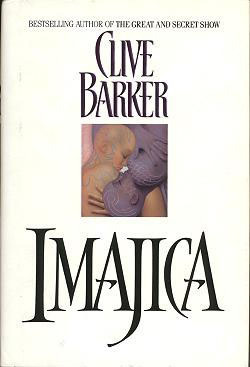
Clive Barker’s Imajica (1991) stands as a magnum opus of contemporary dark fantasy, weaving a sprawling tapestry that bridges five parallel “Dominions” of existence. At once epic in scope and intimate in emotional resonance, the novel challenges traditional genre boundaries by marrying Gnostic cosmology, metaphysical romance, and visceral horror. In this review, I interrogate Barker’s narrative strategies, thematic concerns, and stylistic innovations, situating Imajicawithin both his own oeuvre and the broader landscape of late twentieth-century speculative fiction.
1. The Cosmos of the Dominions
Barker conceives a multiverse of five Dominions—Earth (the Fifth Dominion) and its four mystical counterparts—whose reunification lies at the heart of the narrative. This Gnostic architecture evokes Milton’s Paradise Lost, with its fallen angels and fracturing of unity, yet Barker subverts the Christian paradigm: his “Ascension” is neither purely redemptive nor wholly catastrophic. Instead, it gestures toward an ecstatic transcendence in which individual identity dissolves into a collective “One.” This cosmic vision functions as both mythic scaffolding and moral crucible, compelling readers to ponder the ontological costs of unity and the redemptive potential of rupture.
2. Quest and Romance: The Journey of Gentle and Pie’oh’pah
Central to Imajica are the intertwined odysseys of John Furie “Gentle” and the inscrutable Pie’oh’pah. Gentle’s reluctant role as “Regent” of the reunited Dominions mirrors the archetypal hero’s journey—he must confront the sins of his past, the betrayals of love, and the fickleness of fate. Pie’oh’pah, by contrast, embodies the Other: monstrous yet alluring, from a race exiled to the twilight borders of creation. Their bond—romantic, political, and metaphysical—operates on multiple levels: as a tragic love story, a meditation on colonial power dynamics, and an allegory for the illicit knowledge that unsettles orthodox hierarchies.
3. The Language of Flesh and Blood
Barker’s prose is notoriously corporeal. He revels in the tactile: skin, sinew, and scar tissue become loci of transcendence as much as sites of horror. This “body writing” (to borrow Paul Bishop’s term) subverts Cartesian dualism by insisting that spirit and flesh are inseparable. The result is a language that pulses with both ecstasy and revulsion—moments of sublime beauty give way to grotesque transformation, underscoring the novel’s conviction that creation itself is an act of violent incarnation.
4. Theological Subversion and Mythopoeia
While Barker draws from Judaeo-Christian motifs—angels, demonic archons, forbidden knowledge—he reframes them through a postmodern, pluralistic lens. His cosmology is polytheistic, with the “Autarch” serving less as a tyrannical deity and more as a fractured soul in need of reintegration. In doing so, Barker echoes Joseph Campbell’s monomyth but reincarnates it in a landscape where gods are fallible and miracles demand sacrifice. The theological stakes thus become intensely personal: redemption is not granted by an external savior but achieved through a painful process of self-discovery and reconciliation.
5. Structure, Pacing, and the Challenge of Length
At over eight hundred pages, Imajica is unabashedly vast, and Barker’s structural choices reflect his ambition. The novel is divided into four Books and seven Interludes, a schema that alternates between sweeping panoramas and intimate digressions. Critics have argued that the pacing falters—particularly in the dense recounting of Dominion histories—but these very lengthy passages perform a world-building function typically reserved for secondary texts or appendices in fantasy literature. Barker integrates this lore directly into the narrative, demanding that readers inhabit the myth from within rather than observe it from without.
6. Psychological Depth and Characterization
Beyond its cosmic ambitions, Imajica is a profoundly psychological novel. Gentle’s terror of intimacy, Komo’s quest for vengeance, and Pie’oh’pah’s inscrutable alienness all reflect facets of desire and fear that resonate beyond the fantastic veneer. Barker’s characters are never mere archetypes; they are charged with conflicting impulses, haunted by trauma, and capable of both cruel betrayal and profound compassion. This psychological realism grounds the novel, ensuring that its metaphysical flights remain tethered to the human (and inhuman) heart.
Imajica’s Enduring Resonance
More than three decades after its publication, Imajica endures as a singular testament to Barker’s imaginative audacity. It is a text that resists tidy classification—too philosophically ambitious for pure horror, too gruesomely vivid for traditional fantasy. Yet precisely in this in-betweenness lies its power: by collapsing boundaries between body and spirit, self and Other, Barker invites readers into a realm where creation itself is an act of transgression and reconciliation. For anyone seeking a literary journey that challenges as much as it enthrals, Imajica remains an indispensable odyssey.
Discover more from The New Renaissance Mindset
Subscribe to get the latest posts sent to your email.
 The New Renaissance Mindset