
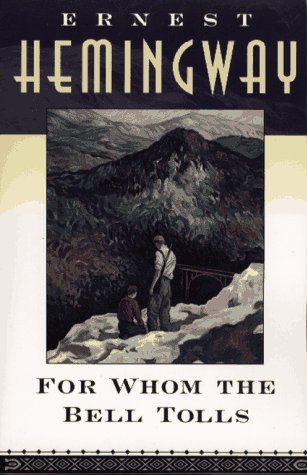
Ernest Hemingway’s For Whom the Bell Tolls (1940) stands as a landmark in 20th-century literature, melding the immediacy of war reportage with profound philosophical reflection. Drawing on his own experiences as a journalist in the Spanish Civil War, Hemingway crafts a novel that is at once an action thriller and an elegy for human interconnectedness in the face of dehumanizing conflict.
Historical and Literary Context
Set in the bitter winter of 1937–1938, the novel plunges readers into the Republican guerrilla struggle against Franco’s Nationalist forces. By invoking John Donne’s meditation—“…never send to know for whom the bell tolls; it tolls for thee”—Hemingway situates his narrative within a tradition of Christian and humanist thought, emphasizing collective fate over individual isolation.
Narrative and Structure
At its core is Robert Jordan, an American dynamiter charged with blowing up a key bridge. Hemingway’s third-person limited perspective aligns us closely with Jordan’s thoughts, fears, and moral quandaries. The novel unfolds in five parts, each broadening from intimate dialogue to full-scale operation, then contracting again toward Jordan’s solitary vigil beneath the pine tree, awaiting inevitable discovery.
Characterization and Relationships
Jordan embodies Hemingway’s “code hero”: stoic, duty-bound, yet internally conflicted. His evolving bond with María—a young partisan scarred by violence—imbues the narrative with tender urgency. Their love scenes, filled with ritualistic language (“I love thee well”), are suffused with both eroticism and sacrament, transforming private intimacy into an act of resistance against war’s brutality. Secondary figures like Pilar, with her mythic “earth-mother” presence, and Pablo, whose wavering loyalties complicate the mission, add psychological and moral depth.
Themes and Symbolism
Three major themes resonate throughout:
- Sacrifice and Duty: Jordan’s mission is both a tactical necessity and a personal crusade, reflecting the tension between ideological commitment and human cost.
- Time and Mortality: The incessant ticking of the clock, the sniper’s breath, and the falling grenades remind us that every moment might be Jordan’s last.
- Collective Solidarity: Through the Donne epigraph and Jordan’s reflections—“What we do for ourselves dies with us; what we do for others and the world remains”—Hemingway asserts the moral imperative of shared struggle.
Style and Language
While often characterized as “sparse,” Hemingway’s prose in this novel is carefully modulated, shifting between terse descriptions of guerrilla tactics and lyrical passages evoking the Spanish landscape. His occasional use of archaic English in dialogue lends the work an almost Shakespearean resonance, reinforcing its epic ambitions.
For Whom the Bell Tolls transcends the bounds of a conventional war novel. It interrogates the moral architecture of conflict, affirms the redemptive power of love, and meditates on the communal ties binding all humanity. Hemingway’s masterpiece endures as both a historical document and a timeless exploration of sacrifice, duty, and the fragile beauty of life under siege.
Discover more from The New Renaissance Mindset
Subscribe to get the latest posts sent to your email.
 The New Renaissance Mindset