
An Ethnographic Fantasy at the Crossroads of Folklore and Natural History
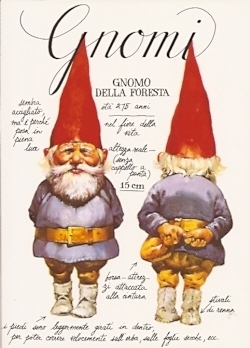
Wil Huygen’s Gnomes (1977) stands as a singular achievement in the realm of illustrated fantasy: it masquerades as a serious field guide, yet unfolds into a rich tapestry of myth, ecology, and cultural commentary. Framed as the definitive monograph on the secret lives of gnomes, Huygen’s text adopts the meticulous tone of a Victorian naturalist while Poortvliet’s sumptuous watercolors lend each entry the verisimilitude of documentary photography. This unlikely marriage of rigorous prose and enchanting imagery invites readers to suspend disbelief and peer into a hidden world—one that at once mirrors and critiques our own.
Form and Structure
Rather than a linear narrative, Gnomes is organized encyclopedically. Chapters traverse the lifecycle (from the subterranean nursery to the twilight years), domestic architecture (the intricately furnished burrows), and seasonal migrations that mirror avian patterns. Each section reads like an academic treatise: taxonomic classifications are given alongside anecdotes of courtship rituals, while diagrams of gnome anatomy are positioned opposite lyrical descriptions of their reverence for flora and fauna. This structure—at once authoritative and playful—invites a dual response: the rational mind delights in Huygen’s pseudo–scientific rigor, while the imagination revels in the rich folklore embedded in every entry.
Interplay of Text and Image
Rien Poortvliet’s illustrations do more than adorn the pages; they animate Huygen’s observations, lending a psychological depth to each subject. A portrait of a matronly gnome, for instance, communicates both her formidable expertise in herbal remedies and her gentle warmth through the play of light on her wrinkled brow. Landscape spreads—root-cellar interiors, woodland clearings lit by lanterns—are rendered with such ecological precision that the viewer senses the damp scent of moss and the sigh of wind through pine needles. The synergy between text and image achieves a kind of “documentary fantasy,” wherein every sketch substantiates the fantasy even as it makes us ponder our own relationship to the natural world.
Themes and Cultural Resonance
At its core, Gnomes is an ecological fable. Gnomes function as caretakers of the earth: healers of wounded birds, stewards of ancient trees, and champions of biodiversity. Their minimal consumption, communal ethos, and deep symbiosis with the environment stand as a subtle rebuke to industrial excess. Published in an era of burgeoning environmental awareness, the book channels a 1970s eco-ethos without resorting to didacticism. Instead, Huygen allows the gnome way of life to speak for itself, embedding moral wisdom in the minutiae of daily routine—how to forage responsibly, how to craft clothing without waste, how to negotiate conflict with neighbors over shared resources.
Literary Lineage and Folkloric Authenticity
_Huygen’s approach owes an intellectual debt to 19th-century naturalists like Gilbert White, while Poortvliet’s aesthetic links back to Arthur Rackham’s fairy illustrations. Yet rather than pastiche, Gnomes achieves a fresh authenticity: it feels as if one has stumbled upon a lost volume of folk wisdom. The text faithfully preserves archaic proverbs—“A gnome who hoards gold for its own sake hoards his own demise”—while weaving in contemporary concerns about habitat destruction. In this way, the book functions both as a vessel of tradition and a mirror held up to modernity.
Critique and Legacy
Some modern readers may find the gender roles and domestic divisions a vestige of older folkloric conventions—gnome households depicted with the male as craftsman and the female as herbalist may jar against contemporary ideals of equality. Yet this conservatism can also be read as fidelity to source material rather than endorsement. Moreover, the book’s episodic format leaves certain “plot” questions unresolved: one longs for a narrative anchor, a protagonist whose journey might crystallize the broader themes. But perhaps that is the point: the gnome world is diffuse, communal, and resistant to the hero’s-journey archetype.
In the decades since its publication, Gnomes has inspired a generation of nature writers, illustrators, and eco-fantasists. It remains a touchstone for anyone seeking to blend scientific curiosity with imaginative wonder, reminding us that the boundary between myth and reality is as permeable as the mossy earth itself.
Gnomes is more than a coffee-table curiosity; it is an eloquent plea for ecological mindfulness, couched in the guise of folkloric scholarship. Its enduring appeal lies in its invitation to rediscover enchantment in the natural world—and to recognize that, sometimes, the smallest beings can teach us the grandest lessons.
Discover more from The New Renaissance Mindset
Subscribe to get the latest posts sent to your email.
 The New Renaissance Mindset