
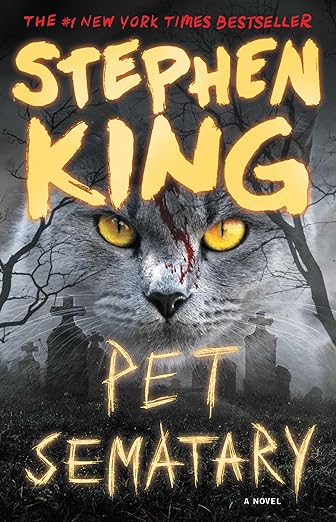
Stephen King’s Pet Sematary (1983) stands apart in his body of work as a profoundly unsettling meditation on grief, mortality, and the human impulse to defy the natural order. More a tragic parable than a conventional horror tale, the novel operates on two intertwined levels: the domestic and the mythic. At its core, it probes the devastating consequences of a family’s confrontation with death, while evoking echoes of ancient folklore and classical tragedy.
A Domestic Tragedy Unraveled
Louis Creed, a Boston physician driven by pragmatism and scientific rationality, relocates his wife Rachel and their young children to a rural Maine community. The move, intended to offer serenity, instead unearths dormant forces of malevolence. King situates the Creed household at the threshold of two burial grounds: the innocently misspelled “Pet Sematary,” where neighborhood children lay their dead cats to rest, and beyond it, an older Micmac burial ground steeped in violent history. Through Louis’s eyes, King renders the familiar—childhood games, family dinners, pet adoptions—into a tableau of impending doom.
King’s portrayal of domestic life is exceptionally vivid: the affectionate routines, the shared jokes, the underlying anxieties of new parenthood. This quotidian realism heightens the novel’s horror, for when death intrudes, it corrupts not distant realms but the very heart of the family. The gradual unraveling of Louis’s psyche—his denial of Rachel’s warnings, his obsessive clinging to the idea of resurrection—mirrors a tragic hero’s descent into hubris.
Mythic Resonances and Literary Allusions
Beneath its surface narrative, Pet Sematary resonates with mythic undertones. The land’s power to reanimate the dead recalls Gothic precedents like Mary Shelley’s Frankenstein, yet King imbues his tale with distinctly American folklore. The indigenous burial ground, referred to in passing by Jud Crandall, the kindly neighbor, stands as a testament to forgotten histories and spiritual boundaries. Its existence suggests that some forces resist human understanding—and that transgressing them invites catastrophe.
King also weaves in Shakespearean tragedy: Louis’s fatal flaw resembles Lear’s blindness to elemental truths and Oedipus’s unwitting trespass against fate. The repeated invocation of the aphorism “sometimes dead is better” functions as a tragic chorus, forewarning the protagonist while underscoring the inevitability of his downfall.
Themes of Grief and Ethical Boundaries
Central to the novel is the theme of grief’s corrosive potential. When young Gage Creed’s accidental death occurs, Louis’s scientific confidence collapses, replaced by an almost primordial terror and desperation. His decision to exhume Gage from the cursed burial ground is born of a father’s anguish—but it is also an act of moral recklessness. King interrogates the ethics of revival: is it ever justifiable to reverse death? The reanimated Gage embodies the answer: a perversion of innocence, a vessel of unnameable dread.
Through Rachel’s traumatic childhood memories—her own sister’s death—and Jud’s tales of the land’s dark history, King emphasizes that those who bury the past do so at their peril. The novel suggests that death, while painful, maintains cosmic balance; to disrupt it is to invite disorder on a scale beyond comprehension.
Stylistic Economy and Psychological Depth
Stylistically, King employs his hallmark clarity and pacing, alternating quiet domestic scenes with jolting, horrific interludes. His prose remains unadorned yet evocative, allowing the psychological depth of his characters to drive the terror. The climax—Louis’s final, heart-wrenching realization—resonates with Shakespearean pathos, leaving the reader to ponder the ethical and existential questions the novel raises.
Pet Sematary transcends its horror trappings to offer a stark reflection on love, loss, and the boundaries of human agency. King challenges readers: Does love compel us to undo death’s verdict, or must we accept mortality’s finality? In this novel, he answers with grim inevitability: some doors should never be opened. As a literary scholar might conclude, Pet Sematary remains one of King’s most philosophically potent works—a modern tragedy that lingers long after its final, whispered line.
Discover more from The New Renaissance Mindset
Subscribe to get the latest posts sent to your email.
 The New Renaissance Mindset