
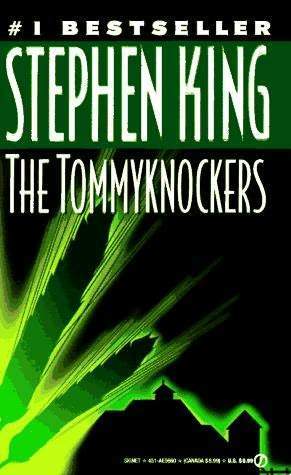
In The Tommyknockers (1987), Stephen King constructs a narrative that is at once a potent exercise in psychological horror and a searing meditation on addiction, creative paralysis, and the perils of unchecked technological ambition. Set in the once-idyllic, now decaying town of Haven, Maine, King orchestrates a slow, insidious invasion: a buried alien spacecraft whose psychic influence transforms the townspeople into hollow, mechanized caricatures of themselves. Under its spell, the inhabitants compulsively excavate their “gift” into bizarre inventions—half-formed machines that echo humanity’s age-old Faustian bargain with progress.
At the novel’s emotional core is Bobbi Anderson, a writer and recovering alcoholic whose life has become as barren as Haven itself. King’s choice of Bobbi as point-of-view anchor is both strategic and deeply humane: as she regains her clarity, readers track the novel’s mounting dread through the eyes of someone all too familiar with the destructive allure of dependence. Her struggle against the Tommyknockers’ psychic pull mirrors the insidious slide into substance abuse—an addiction not of her own choosing, but one forced upon her by an external entity that promises power while devouring the self.
King’s prose in The Tommyknockers is at its most evocative when describing the metamorphosis of the townspeople. He charts their regressions—from kindly neighbors to twitching husks ruled by the singular objective of “unearthing” the alien craft—with clinical precision and an almost scientific awe. The transformations are both grotesque and tragic: a dentist fashions teeth-like shards of metal; a librarian replaces her mind with a network of cables; children craft their peers into biomechanical playthings. These lurid images work on multiple levels: as visceral body horror, as allegory for the dehumanizing effects of industrialization, and as a dark mirror to our own century’s blind faith in technology’s omnipotence.
Structurally, the novel alternates between tension-building set pieces and more contemplative interludes, often via Bobbi’s interior monologue or excerpts from the manuscript she types in fits of telepathic inspiration. This layered storytelling affords King the luxury of both rapid pacing and reflective depth. He rarely allows the narrative to stagnate: each new invention, each additional shred of technopathic influence, ups the ante—yet he also pauses long enough to consider the human cost. In so doing, King avoids the pitfall of pure spectacle and reminds us that the most terrifying engines of horror are those that strip us of agency and identity.
Thematically, The Tommyknockers engages with the Cold War anxieties of its era: the dread of infiltration, the fear that our grandest achievements may be Trojan horses, and the uneasy recognition that genius and madness often walk hand in hand. Yet King transcends mere contemporary allegory: he probes deeper questions about creativity itself. What does it mean to create if creation becomes an end that consumes the creator? And how do we reclaim our humanity when our tools—literal or metaphoric—begin to shape us more than we shape them?
Critically, the novel has sometimes been dismissed as overlong or overindulgent, but such critiques overlook its ambition. At nearly six hundred pages, The Tommyknockers is indeed sprawling—yet its breadth allows King to excavate not only the secrets beneath Haven’s soil but the recesses of human vulnerability. His willingness to luxuriate in atmosphere, character detail, and speculative invention yields a world that feels lived-in, even under siege.
In the final reckoning, King offers both a triumph of human will and a mournful elegy for innocence lost. Bobbi’s rally against the alien influence, aided by a small band of friends, reasserts the power of collective resistance and the redemptive force of storytelling itself. The Tommyknockers thus stands as a testament to King’s mastery of the horror form: he can terrify and enlighten in equal measure, reminding us that our greatest monsters are not always the ones that come from outer space, but the ones we carry within.
Discover more from The New Renaissance Mindset
Subscribe to get the latest posts sent to your email.
 The New Renaissance Mindset