
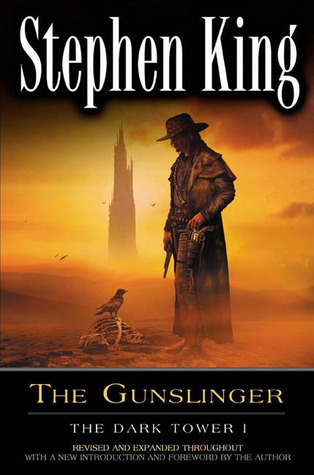
“The man in black fled across the desert, and the gunslinger followed.” That opening sentence is almost a programmatic summons: spare, inexorable, and immediately mythic. The Gunslinger announces itself as a story of pursuit and of destiny, and Stephen King’s first volume of The Dark Tower cycle repays a close, patient reading by readers who are willing to accept a hybrid of forms — western, high myth, horror, and a deliberately fragmentary fantasy.
Form and tone
King’s stylistic choice in The Gunslinger is an economy of sentence and a parable-like rhythm that often reads less like his contemporary realist novels and more like a modern fable or a Book of Hours. The prose is restrained, almost ascetic: details are chosen with the precision of a weapon. When King slows for description, the images are tactile and cinematic — sand, rust, a cigarette’s ash — but the narrative more often advances through dialogue and elliptical scene changes, producing a dream logic that suits the book’s odyssey.
This tonal austerity is strategic. By compressing the language, King shifts emphasis from exposition to moral and metaphysical query. The reader is deprived of comfortable explanatory frameworks and must accept, like Roland, a world in which past and present, technology and decay, myth and pulp coexist awkwardly and insistently.
Roland as anti-hero and the ethics of the quest
Roland Deschain is a fascinatingly spare protagonist: a gunslinger in the literal and mythic senses — a professional, an exile, a man shaped by a code older than his own name. King constructs Roland so that the reader often sees him through absence as much as presence: the character’s interior life is suggested through actions and silences rather than expository interior monologue. This restraint produces an ambivalent empathy. Roland is heroic by calling (the quest for the Dark Tower), but morally ambiguous in his willingness to sacrifice others to that end.
The episode with Jake — an emotionally wrenching moral center of the book — crystallizes this ambiguity. King stages a profound ethical dilemma: loyalty to one’s quest versus responsibility to an individual life. Roland’s decision is not presented as monstrous for shock value; it is dramatized as the necessary cruelty of a man for whom the Tower is ontologically prior. The novel forces the reader to ask whether ends can sanctify means, and whether heroism and obsession can be disentangled.
Myth, genre, and intertextuality
One of The Gunslinger’s most interesting achievements is its bricolage of genres. King borrows the iconography of the American western — the lone rider, the desert, the duel — and refashions it with mythic and fantasy structures: the Tower as axis mundi, the presence of ka (a kind of fate), and overt allusions to quests from folklore and Arthurian romance. The result is neither pure pastiche nor simple homage; instead, King creates a palimpsest in which modern pop culture and ancient myth speak across and through each other.
This layered intertextuality is also political in a subtle way: the collapsing of timelines and the decayed technological artifacts suggest a post-cataclysmic modernity, which allows King to question progress, memory, and the persistence of narrative authority. The Man in Black, who functions as both tempter and cosmological hinge, reads like a trickster figure — an embodiment of narrative entropy who interrogates not only Roland’s motives but the very possibility of meaning.
Structure and pacing
Structurally, the novel resists a tidy plot arc. It is episodic, composed of set pieces that accumulate rather than resolve. This can be disorienting: scenes begin with a cinematic immediacy and end without full resolution, as if the book were intentionally practicing omission. Such fragmentation is a double-edged sword. It produces the unsettling atmosphere that fuels the book’s mythic force, yet it can frustrate readers who expect more conventional explanatory closure.
Aesthetics and significance
As the opening installment of a sprawling cycle, The Gunslinger operates more as an evocation than as a rounded novel. Its power lies in the way it sets a tone — the ethics of a questing mind, the moral cost of single-mindedness, and the uneasy coexistence of the intimate and the apocalyptic. King’s language is at once plainspoken and incantatory; he can deliver a domestic detail with the same moral weight as an apocalyptic image.
For students of modern American mythmaking, the book poses interesting questions about how contemporary fiction reworks older narrative archetypes. King is not merely recycling motifs; he is interrogating why stories of pursuit and home, desire and ruin persist — and what they ask of those who tell them.
Recommendation
The Gunslinger is not an easy, consoling read. It is austere, morally uncomfortable, and intentionally incomplete — a book that seeks to provoke rather than to pacify. Read as the first movement of a larger symphony, it functions brilliantly: it introduces a voice, a moral problem, and a universe. Approached as a standalone, it can feel enigmatic and occasionally undernourished.
I would recommend it to readers interested in mythic structures reimagined within contemporary fiction, to those who appreciate moral ambiguity in heroic characters, and to King’s readers willing to trade familiar narrative gratuities for a darker, more meditative odyssey. For anyone studying how genre can be transmuted into allegory, The Gunslinger is a compact and revealing laboratory.
Discover more from The New Renaissance Mindset
Subscribe to get the latest posts sent to your email.
 The New Renaissance Mindset