
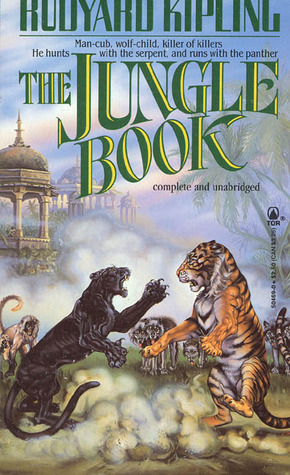
Rudyard Kipling’s The Jungle Book (1894) sits oddly and brilliantly between children’s tale and moral fable, between ethnographic curiosity and wild lyric. Read simply as a collection of animal stories, it is superb entertainment: taut, vivid, and full of suspense. Read as literature, it becomes a compact study in moral pedagogy, imperial imagination, and narrative voice — a work whose charm and unease are inseparable.
Kipling’s book is episodic by design. The volume stitches together Mowgli’s coming-of-age tales with animal adventures such as “Rikki-Tikki-Tavi,” “Toomai of the Elephants,” and “The White Seal.” That variety is a strength. The Mowgli stories function as a quasi-mythic Bildungsroman, examining identity, belonging, and law; the other stories explore themes of duty, courage, and the limits of human authority from different angles. The whole is held together by Kipling’s remarkable ear for cadence — songlike refrains, short imperative sentences, and a vocabulary that shifts effortlessly from colloquial banter to ceremonial pronouncement.
Kipling’s use of language is central to the book’s power. He fashions animal speech that is at once anthropomorphic and true to an animal logic; the “Law of the Jungle” reads like a set of axioms — practical, ritualized, sometimes harsh — and it supplies an ethical architecture for the stories. This Law is not merely sentiment; it enforces obligations and duties, and through it Kipling interrogates what social order might require of the individual. One of the book’s most memorable formulations — “For the strength of the Pack is the Wolf, and the strength of the Wolf is the Pack” — epitomizes that balancing of individual and collective claims, and it is emblematic of the moral instruction woven through the narrative.
Formally, Kipling writes as an inheritor of oral tradition. He replicates the register of campfire tale and nursery song, interspersing prose with short poems and chants that serve both to entertain and to ritualize. The result is a texture that feels communal: tales told and retold, each carrying lessons meant to be remembered. Yet beneath the warmth of story-telling lies a muscular naturalism — vivid descriptions of landscape and animal behavior that anchor the fable in sensible detail rather than pure allegory.
This anchoring in place has two consequences. On the positive side, Kipling’s India (or rather, his literary India) is richly imagined: climate, fauna, and human habitations are rendered with an eye for specificity. On the other hand, the book is a product of its imperial moment; its perspective is filtered through the sensibilities of a British writer entrenched in the late-Victorian worldview. Scholars and readers must therefore hold two readings in tandem: admire the artistry while refusing to naturalize the political assumptions embedded in the work. The book’s genial paternalism and occasional endorsement of hierarchical order can be uncomfortable today; yet it is precisely the tension between Kipling’s sympathy for his characters and the book’s imperial shadow that makes the text fruitful for critique.
Characterization is economical but unforgettable. Mowgli is archetypal: he is both uncanny — a human raised by wolves — and profoundly ordinary in his desires to belong and to be recognized. Baloo and Bagheera (and even the fearsome Shere Khan) are sketched with economy and wit; each animal embodies ethical qualities without becoming mere moral tokens. “Rikki-Tikki-Tavi,” a story set in the domestic space of the bungalow garden, functions as a concentrated thriller while also reversing the civilizing trope: the protector is a mongoose, not the human household. These inversions allow Kipling to complicate simple binaries — wild/civilized, native/colonial — without fully escaping the ideological horizons of his time.
What elevates The Jungle Book beyond pedagogical animals and moral aphorisms is the book’s capacity to unsettle its own lessons. The Law is shown to be both life-preserving and unforgiving; courage is admirable, but often demands costly sacrifice. Kipling’s narratives do not offer easy consolations. Instead they train readers — child and adult alike — to notice trade-offs: between community and self, habit and law, tenderness and ruthlessness. That ambiguity is what keeps the book alive for modern readers and critics.
Finally, the book’s afterlives — theatrical adaptations, illustrations, and the famously sanitized Disney retelling — testify to its protean imagery, but they also demonstrate the ease with which Kipling’s complexities can be flattened. To read The Jungle Book well today is to read it against its popular transmogrifications: to appreciate its lyricism and narrative craft while also bringing a critical lens to its ideological residues.
The Jungle Book is a major minor classic — compact, artful, and morally intricate. It rewards close reading: the prose’s economy conceals a dense moral imagination and a complex relationship to power. I would recommend it both as a primer in storytelling craft and as a text for discussing how literature can teach — and disguise — the values of its age. Read it aloud, and listen for the Law in the rhythm; read it quietly, and listen for the questions it refuses to answer.
Discover more from The New Renaissance Mindset
Subscribe to get the latest posts sent to your email.
 The New Renaissance Mindset