
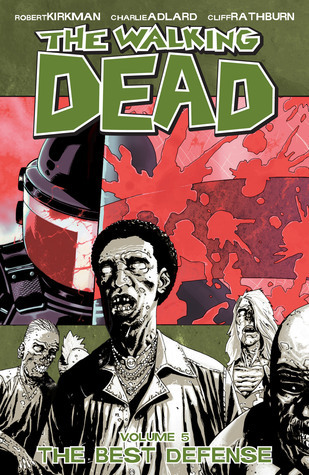
Robert Kirkman’s The Walking Dead has always been a study in the sociology of collapse; Volume 5, The Best Defense, continues that project with an increasingly clear political and moral lens. This collection deepens the series’ central question: when structures fail, what patterns of life and meaning persist, and who gets to decide the rules for a new order? Kirkman’s gift is not simply the invention of ghoulish spectacle but the patient excavation of human institutions — family, leadership, justice — beneath the ash.
Overview (light on spoilers).
This volume slows the headline thrills and turns inward: the external horror persists (the dead are always at the periphery), but Kirkman increasingly stages conflicts that are human-shaped. The group’s survival is no longer a pure matter of outrunning the undead; it has become a test of governance and ethical negotiation. In The Best Defense the action often reads as a series of moral experiments, with characters proposing, testing, and revising rules that might permit a life worth living. The result is less a sequence of set-pieces than a civic drama in fragments.
Themes and motifs.
Two interlocking themes dominate. First, the institutionalization of survival: Kirkman explores how rules, roles, and artifacts of “civilization” — fences, watch posts, organized labor, designated punishments — reemerge quickly because they work, even when their moral legitimacy is unstable. Second, the cost of leadership: Rick and the group’s other authority figures are forced into decisions that reveal leadership as a practice of compromise and violence rather than as moral example. The walker herself (the undead) becomes a negative space in which human ambitions and fears are projected; she is less an antagonist than a continuous reminder that the ethical debates are real and urgent.
Motifs of domesticity — broken toys, a kettle left on a stove, a child’s silence — recur throughout the volume. These small objects act like counterweights to the larger political questions: they insist that the stakes are not abstract; the goal is not merely survival but the preservation of a life with tender particulars.
Narrative craft and characterization.
Kirkman writes in a register that privileges long-term consequence over immediate catharsis. Character development is incremental: small gestures accumulate meaning. When characters argue about punishment or the allocation of resources, the dialogue is spare but freighted with prior history; decisions are intelligible because the world has taught its inhabitants painful lessons. Kirkman’s plotting here is patient and rhetorical — each conflict functions as both an immediate plot problem and as a parable about collective life.
This patient approach sometimes frustrates expectations for nonstop action, but it pays off narratively: choices stick. The reader is left with the sense that the consequences of decisions in one chapter continue to shape the moral topography of later scenes. That “stickiness” is one reason the series reads like a long-form novel in episodic clothing.
Art and atmosphere.
Rendered in stark black-and-white panels, the visual language emphasizes texture — weather, grime, the worn surfaces of human dwellings — which reinforces the book’s anthropological impulse. Silence is used as a formal device; long, wordless sequences compel the reader to inhabit the scene, to feel the quiet before and after decisions are made. This restraint in imagery mirrors the restraint in narrative — both conserve shock for those moments when a moral choice snaps.
Critique.
If one reservation can be offered, it is that the book’s dour realism can occasionally calcify into pessimism. Kirkman’s ethical puzzles are often presented without easy solutions, which is artistically consistent but may feel emotionally draining: the world he builds is stubbornly resistant to redemption. For readers craving cathartic triumphs or full moral closure, this volume can feel unsparing. Yet that very refusal to tidy up is arguably the point: the work insists that human polity is messy, provisional, and morally costly.
The Best Defense is a mature instalment in Kirkman’s serial experiment. It reframes the walking dead as a political hazard and uses genre mechanics to ask serious questions about the forms social life must take under extreme conditions. Read as an exercise in speculative sociology and ethical imagination, this volume is quietly powerful: it refuses spectacle as an end in itself and instead uses the apocalypse as a lens on how humans rebuild meaning — imperfectly, painfully, and with stubborn if compromised hopes. For readers interested in what horror fiction can teach us about politics and the human condition, this is one of the series’ more intellectually satisfying stops.
Discover more from The New Renaissance Mindset
Subscribe to get the latest posts sent to your email.
 The New Renaissance Mindset
What an outstanding and insightful review 🌟. You’ve captured not just the essence of The Walking Dead: The Best Defense but also its deeper resonance as a study of human society under collapse. I truly appreciate how you highlight Kirkman’s ability to move beyond “zombie spectacle” into questions of governance, morality, and the fragile structures that sustain meaning.
LikeLiked by 1 person
Once again, Vermavke, you honour me! I’m very grateful for your remarks!
As far back as I can remember, when reading comments on the zombie genre, it is seen as an allegory for human greed and consumption, or a warning of uncontrolled capitalism. Some authors and film makers tossed in satire about the dangers of nuclear holocaust, etc. I often try to look at the cartoonish interpretations that focus on Darwinism (survival of the fittest tropes), but find that too simplistic.
Kirkman manages to encapsulate the human condition in all its facets and presents us with the outcome possibilities experienced during no-win situations: the constant questions left from these situations… why did I survive ? & what is surviving costing me?… he keeps us captured in this horrible world with hope that the characters will eventually answer “should we survive?”
Again, I thank you with all my heart for your comments and I apologize for my spontaneous and perhaps loquacious response.
LikeLiked by 1 person