
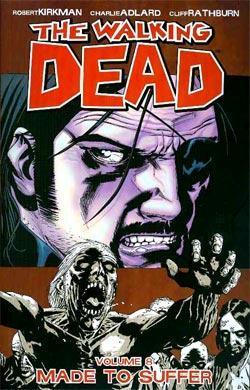
Robert Kirkman’s Made to Suffer functions like a tonal accelerator in the longer engine of The Walking Dead: it tightens the screws on previously established tensions and converts slow-burn unease into explosive moral encounter. Read as a standalone meditation, this volume is less about the mechanics of survival than about what—ethically, emotionally, politically—survives in us when the old rules vanish. Kirkman, working within the comic medium’s capacity for economy and sequence, stages a conflict in which violence is not sensational amusement but a revealing crucible.
At its core, Made to Suffer is a study of authority and theatricality. Two competing models of governance—Rick’s vulnerable, improvised, democratic band of survivors and the Governor’s polished, paternalistic fiefdom—come into collision. The Governor is one of Kirkman’s most striking inventions because he performs civility as a kind of costume: his benevolence is scripted, his cruelty rehearsed. Against that performative calm, the prison community’s leadership appears raw and ethically messy but authentically fragile. That contrast forces the reader to ask what we value more in catastrophe: the appearance of order or the awkward necessity of moral improvisation.
Kirkman’s writing here is deceptively plain. He rarely lectures; instead he sets up situations that force characters into moral choice, then watches consequences ripple outward. Revenge, retribution, mercy—those familiar ethical categories are interrogated without tidy answers. The title, Made to Suffer, works on multiple levels: it names the physical brutality of the world, but also suggests how social structures and personal obsessions manufacture suffering—how grief, pride, and the desire to dominate become engines of pain. The story insists that suffering is not only an effect of the apocalypse; it is a currency people mint themselves.
Character work is the volume’s steady beating heart. Rick, stripped of the safety of law and institutions, becomes an exemplary case of leadership by crisis: he is decisive but fallible, protective but liable to hardening. The Governor, conversely, is an anatomy of charisma turned malignant—what begins as orderliness curdles into sadism. Secondary figures—those who act as conscience, impulse, or collateral in the conflict—are drawn with a brisk, unsentimental hand. There is a palpable human cost to every choice; Kirkman rarely lets the reader forget the faces that pay for ideological clashes.
The comic medium amplifies the theme work. The visual rhythm—panel size, the use of silence between images, moments of lingering close-up—compounds tension in ways prose alone would struggle to replicate. The art does not romanticize violence; instead it makes it immediate and ugly, which paradoxically preserves the reader’s empathy. Scenes of community life in the prison are often rendered with cramped, utilitarian panels that feel lived-in; sequences that emphasize the Governor’s world, by contrast, can feel ostentatious, staged—another visual echo of the book’s thematic bifurcation.
What elevates Made to Suffer beyond genre exercise is Kirkman’s refusal to mythologize his protagonists. Heroes and villains are porous categories. Even acts of brutality are shown within contexts: personal loss, fear, and the spectral logic of survival. This moral ambiguity is not evasive; it is the text’s ethical muscle. Readers who approach the volume seeking cathartic heroism will find discomfort instead—an invitation to witness, and to complicate, their sympathies.
Pacing is ruthless and efficient. Kirkman balances long, simmering scenes of community and conversation with sudden, wrenching ruptures. The oscillation keeps the reader off-balance in a manner thematically consonant with a world that never allows settling. There is an operatic quality to the volume’s crescendo: events set in motion earlier in the series here pay off with narratively satisfying—if ethically bruising—consequences.
In short, Made to Suffer is one of the series’ more philosophically engaged instalments. It treats apocalypse as an ethical laboratory, interrogating how leadership, memory, and performative civility survive when law collapses. The volume is uncompromising in its examination of pain—how it is inflicted, how it is endured, and how, too often, it is deliberately produced. For readers interested in comics that use genre trappings to ask hard social and moral questions, this volume is essential reading: harrowing, thoughtful, and strangely human in its insistence that even in the worst of times people remain morally complicated.
Recommended for those who want their zombie fiction to ask questions rather than simply tally scares.
Discover more from The New Renaissance Mindset
Subscribe to get the latest posts sent to your email.
 The New Renaissance Mindset