
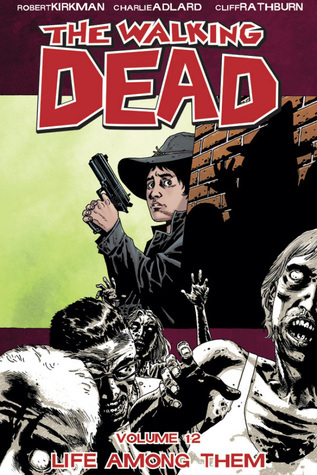
Life Among Them marks a crucial inflection in Robert Kirkman’s long-running serial: a volume that, more than many others, forces the reader to watch social order be reimagined in microcosm. Where earlier arcs traded primarily on shocks and survival logistics, this twelfth trade collects episodes in which the real drama becomes cultural — the negotiation of meaning, ritual, and memory in the wake of collapse.
Narrative architecture and pace
Kirkman’s plotting here is deceptively economical. Rather than piling set-pieces, he disperses tension across multiple, quieter confrontations: internal debates about leadership and legitimacy, small-scale power plays around resources, and interpersonal reckonings between characters whose moral choices have become their identities. This restraint allows Charlie Adlard’s line work to breathe; panels expand from frantic gutters into composed frames that emphasize the domestic — a kitchen table, a schoolyard, a cemetery — converting the everyday into sites of ideological contest.
The volume’s tempo is variable in an intentional way. Action punctuates long stretches of dialogue and community-building, and those pauses are not narrative dead space but analytical fulcrums: the reader is given time to register how communities morally reconstruct themselves. Kirkman trusts the reader to find dread in what is not said, in the silences between survivors who must now perform civility to preserve anything resembling a future.
Themes: society, memory, and the politics of care
At the thematic core of Life Among Them is the question: what does it mean to be among others when the norms that once bound a society have been sundered? The title’s emphasis on “among” is instructive — this volume focuses less on the spectacle of survival and more on cohabitation, governance, and the ethics of belonging.
Memory and ritual recur as motifs. Graves, commemorations, and the small ceremonies survivors enact become ways of authorizing community continuity. Kirkman stages memory not only as mourning but as political currency: those who control the narrative of loss often control the social order that forms in its wake. That insight gives the volume its most chilling scenes, where civic rituals are stripped of consent and repurposed for domination.
Closely related is the politics of care. In a world where resources are finite, caring for others can be framed alternately as heroic altruism or as a threat to group survival. Kirkman deliberately complicates easy moral binaries: caregiving can be a soft tyranny when weaponized, and ruthlessness can sometimes be a form of preservation mistaken for moral clarity. This ambivalence is one of the series’ strengths, and Life Among Them refines it.
Character work and moral psychology
Kirkman’s long-form approach to character — the accrual of choices over time — pays dividends here. Rather than resetting personalities after each crisis, the volume allows previously seeded traits to surface in full moral complexity. Figures who were once purely sympathetic are asked to justify compromises; erstwhile antagonists reveal practical acuities that make them unexpectedly useful in the art of rebuilding.
The psychological realism comes from small gestures: a flinch at a remembered name, an offhanded joke that masks trauma, or the meticulous tending of a small garden. These details humanize the grander political problems and remind the reader that polity-building is, at base, an aggregate of intimate acts.
Adlard’s character designs — economical, stark, insistent — complement this psychology. Facial close-ups in moments of deliberation are used sparingly but precisely, inviting the reader into the mental calculus of characters who are perpetually balancing compassion and self-preservation.
Visual rhetoric and the comic form
As always with The Walking Dead, the comic medium itself is a meaningful agent. The black-and-white palette enforces moral ambiguity: shadows are not merely horror flourishes but signifiers of ethical uncertainty. Panel composition often juxtaposes domestic frames against the ruined landscape, producing an aesthetic tension between the desire for normalcy and the ever-present possibility of rupture.
Kirkman’s script respects negative space: pauses are drawn as much as written. Adlard’s pacing through gutters — lingering over a long silent sequence or accelerating through tight panel grids — choreographs reader attention, converting the act of reading into a performance of communal endurance.
Cultural resonance and literary lineage
Viewed through a broader literary lens, Life Among Them engages with dystopian and pastoral traditions simultaneously. It performs the Rousseauite question of what social contracts might look like amended for a post-collapse world, while also inheriting the American frontier myth: communities remade by hardship, negotiating law and custom at the margins. Unlike many post-apocalyptic narratives that valourize lone heroism, this volume insists that the real labor is social and legal — a kind of small-scale constitutionalism born at the kitchen table.
Life Among Them is a thoughtful, unsettling mediation on how human beings attempt to make meaning and order after systemic failure. Kirkman’s script, paired with Adlard’s disciplined art, converts the quotidian into the profound: governance, mourning, domestic care, and narrative control become battlefields no less intense than any physical fight with the undead. For readers interested not only in horror but in the sociopolitical imagination of recovery, this volume offers rich, uncomfortable material — a reminder that the most enduring monsters might be the compromises we accept in the name of survival.
Discover more from The New Renaissance Mindset
Subscribe to get the latest posts sent to your email.
 The New Renaissance Mindset