
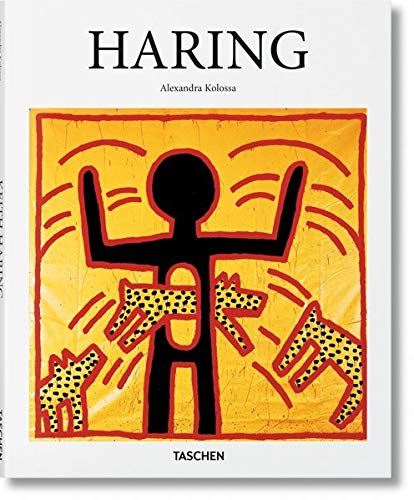
Alexandra Kolossa’s Haring reads like a choreography of image and intimacy: at once biographical sketch, ekphrastic meditation and elegy for an era in which art made itself at the street’s edge. The book resists the tidy architecture of conventional life-writing; instead Kolossa arranges her pages as a series of glances — quick, incandescent, then gone — that mimic the mercurial work of her subject. What she produces is less a catalogue of events than a thinking-through of what it means to make work that is public and bodily, playful and political.
Kolossa’s principal achievement is tonal. She writes with the terse exuberance of a speaker who has lived among frenetic images and knows how to read their small betrayals. Her sentences often perform the same compact, gestural logic as the drawings she contemplates: loops that double back on themselves, abrupt emphases, the economy of line that leaves room for motion. This stylistic affinity is not mere mimicry; it is argument. By rendering form in language that mirrors visual immediacy, Kolossa stages a persistent thesis about art’s ontology: that meaning is produced in movement, in the act of being-seen rather than in the slow, distanced gaze of the museum-goer.
Structurally the book favours montage over chronology. Episodes of public performance — murals, subway drawings, and block-party spectacles — are intercut with quieter domestic scenes and archival interrogations. This alternation creates a productive dissonance. Public works, which assert themselves in splashes and rhythmic repetition, are set against intimacies that reveal the human costs and contradictions of making culture in an age of precarity. Kolossa does not sentimentalize these costs; she attends to them with a careful, sometimes forensic tenderness. The result is a portrayal that is humane without being hagiographic.
A recurrent intellectual thread is the politics of visibility. Kolossa reads the work she examines as an attempt to claim space: social space, queer space, and the literal urban canvas. She asks how images that are at once cartoonish and uncompromising can be political in ways that exceed programmatic activism. In doing so she situates her subject within a genealogy of public artists and pop-provocateurs — not to reduce the work to influences, but to show how it negotiates legacy, commodification and activism. Her reflections on how art circulates — from wall to gallery, from subway to souvenir table — are some of the book’s sharpest. She is skeptical of market assimilation while recognizing the difficulty of maintaining purity in a world that monetizes visibility.
Kolossa’s prose is most compelling when it slows into specific description. Short, repeated motifs — a crawling figure, a radiant baby, the pulsating line — are given textured treatment: not merely named, but felt. When she describes the physicality of drawing in public — the breath, the spray can’s hiss, the precariousness of working at night — these passages conjure the embodied labor behind images otherwise experienced as instant icons. They remind the reader that line and labor are inseparable.
There is, however, an occasional ache for more archival rigour. At times Kolossa’s lyrical impulses outpace verification; she leans into plausible inference rather than exhaustive documentation. For readers seeking a comprehensive chronological biography or an exhaustive catalogue raisonné, Haring will feel intentionally partial. But this is part of the book’s design: Kolossa prefers interpretive aperture to exhaustive closure. Her method chooses resonance over completeness, which will gratify readers who come to literature for insight rather than for archival assurance.
The book also performs a quiet ethical project. Kolossa refuses the flattening nostalgia that often attends retrospective writing about artists whose lives were cut short by illness and social neglect. Instead she insists on complexity: on mistakes, compromises, and the interplay between joy and vulnerability. In this respect Haring is as much a cultural document as a portrait: it maps a moment when aesthetics and desire, commerce and compassion, collided in ways that continue to have relevance.
In sum, Alexandra Kolossa’s Haring is a musician’s essay in which image and voice keep time with one another. It is best approached not as a definitive account but as a supple, incisive companion — a book that will change the way you look at public marks on city walls and, perhaps more importantly, the people who make them. Recommended for readers interested in the intersection of art history, queer studies and urban culture, and for anyone who wants a literary, humane account of how images can both reveal and remake the world.
Discover more from The New Renaissance Mindset
Subscribe to get the latest posts sent to your email.
 The New Renaissance Mindset