
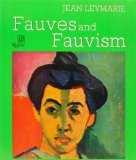
Jean Leymarie’s Fauves and Fauvism reads less like a conventional survey and more like a practiced act of recovery: it brings into focus a moment that, though brief, reoriented the possibilities of painting for the twentieth century. Leymarie approaches the subject with the twin tools of an attentive connoisseur and a synthetic historian—he situates the movement’s eruptive colour and flattened space within the longer currents of French modernism, while repeatedly returning the reader to the canvas itself so that argument is always grounded in visual fact.
What the book does
At the book’s core is a persuasive thesis: Fauvism was not merely a stylistic outburst of arbitrary colour, but a disciplined rethinking of pictorial means. Leymarie argues that the so-called “wild beasts”—Matisse foremost among them, but also Derain, Vlaminck, Dufy, van Dongen, Marquet, Friesz and others—were attempting to reassert colour’s primacy as a structural, expressive and even ethical element of painting. Their use of saturated, non-local colour, thick contouring and flattened planes was a program of simplification aimed at immediacy and communicative intensity, not simple shock value. Leymarie traces how those aims crystallized during the fraught years around the 1905 Salon d’Automne and demonstrates the movement’s indebtedness to, and departures from, Impressionism, Post-Impressionism and Cézanne.
Strengths
The author’s most compelling gifts are his clarity of exposition and his eye. Passages of close visual analysis—where he teases out how a single chromatic decision reorganizes a composition—are models of how to read paint. He also excels at mapping interpersonal and institutional contexts: the Salon d’Automne controversy, the role of dealers and critics, the informal rivalries and alliances among the painters. When he writes about Matisse’s daring restraint or Derain’s architectural sense of colour, the balance between description and interpretation is exacting; the argument never drifts into mere rhetoric.
For readers who care about objects, the book’s attention to provenance, exhibition history and reproduction is useful. Editions that include plates do the book an extra favour: Leymarie’s arguments gain authority when paired with the images he discusses, because so much of his case depends on seeing subtle shifts in hue, edge and facture.
Limits and quarrels
The book is strongest as an aesthetic history, and that strength is also its principal limitation. Social, political and transnational dimensions—questions about patronage, market forces, gender, and the global currents that funnelled materials and motifs into Parisian studios—receive comparatively light treatment. The cultural anxieties and imperial contexts of early-twentieth-century France, which can illuminate why certain colour choices read as radical or transgressive at the time, are not developed with the rigour contemporary readers might expect.
There is also a tendency toward canonical centrality: Matisse is rightly foregrounded, but some of the lesser-studied figures are sketched in ways that gesture toward complexity without fully engaging it. Scholars interested in revisionist or postcolonial readings of modernism will find openings in Leymarie’s account but must look elsewhere for sustained engagement.
Contribution and audience
Despite these caveats, his study remains a concise and authoritative primer on Fauvism. It performs an important historiographical work: clarifying that Fauvism’s radicalism lay in its redefinition of pictorial rules rather than mere flamboyance. The book is well suited to advanced undergraduates, graduate seminars on modern art, museum professionals preparing exhibitions, and general readers who already have a sympathetic ground in art history. For anyone teaching the period, the author supplies readable close readings that can frame a seminar discussion around questions of form, intention and reception.
Fauves and Fauvism is a lucid, image-centred account that rescues a movement too often reduced to a catchphrase about “wild” colour. Jean Leymarie combines connoisseurship, historical sweep and clear critical intelligence to show that Fauvism belongs among the decisive aesthetic moments of modern painting. Its modest blind spots—underdeveloped social readings and a tendency toward canonical focus—do not diminish its value as a compact, bracing guide to why, for a few electric years, colour itself became a means of renewing how the world might be seen.
Discover more from The New Renaissance Mindset
Subscribe to get the latest posts sent to your email.
 The New Renaissance Mindset