
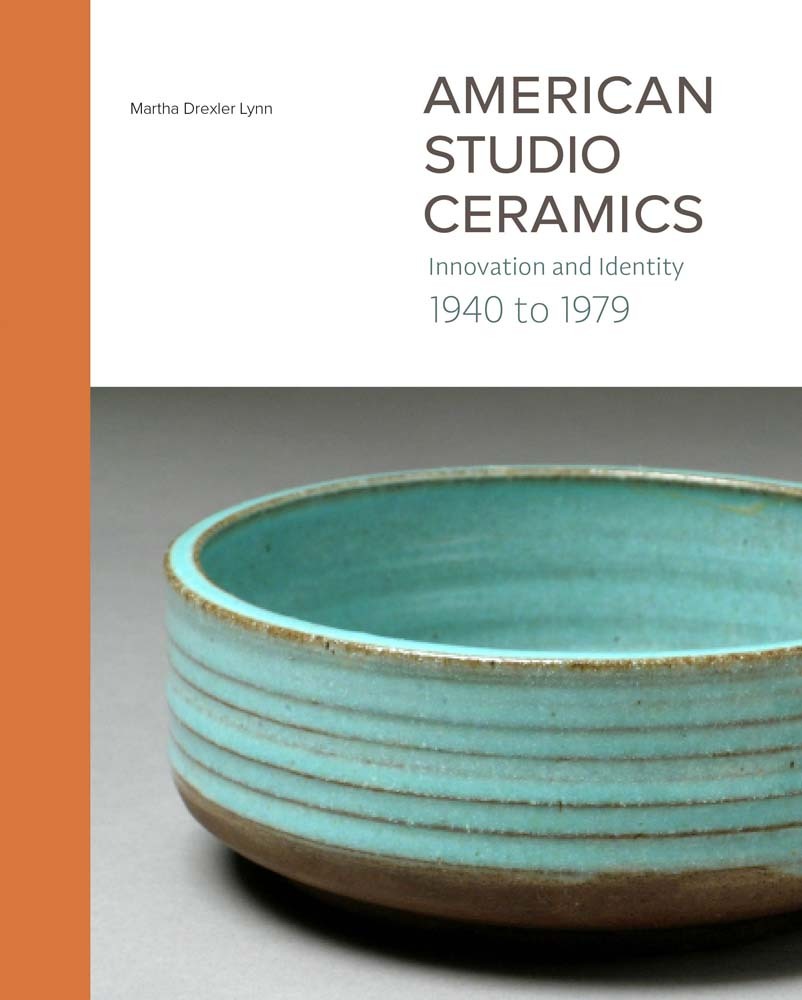
Martha Drexler Lynn’s American Studio Ceramics is a capacious, corrective history: ambitious in chronological sweep, painstaking in archival detail, and insistently revisionist in its aim to relocate mid-century ceramics within the narrative of American modernism. Lynn’s central claim — that between roughly 1940 and 1979 studio ceramics migrated from domestic craft into the arena of fine art, and that this transformation was shaped by shifting institutions, technologies, regional cultures, and markets — is not simply asserted but demonstrated across a wide array of case studies, exhibition histories, and artist networks.
Structurally the book is both chronological and thematic. Lynn moves the reader through the immediate postwar years of experimentation (where mentorships, pottery schools, and GI education programs mattered), into the more fractious 1960s and 1970s when questions of scale, abstraction, and the object’s relation to the pedestal came to define debates about art-world legitimacy. Her chapters read like a series of tightly argued essays: each combines biographical attention with institutional context (galleries, museums, craft organizations), technical description (glaze chemistry, kiln technology), and market dynamics. This three-pronged method — material, institutional, and social — is one of the book’s greatest strengths because it resists facile binaries (craft vs. art) and replaces them with a layered account of how aesthetic identity is constructed.
Lynn’s research apparatus is impressive. The book is richly illustrated and lavishly footnoted, and she mines exhibition catalogues, periodicals, and artists’ papers to recover both durable figures (Voulkos, Sèvres-informed studio potters) and lesser-known practitioners whose inclusion alters our sense of the field’s heterogeneity. Reviewers have noted that this inclusiveness is important: Lynn rescues “obscure” but revealing careers from the margins and thereby enlarges the canon rather than merely reiterating it.
That said, the book’s very scope produces inevitable trade-offs. The panoramic approach sometimes compresses complex regional scenes into schematic summaries; some commentators have pointed out that certain geographic areas — notably parts of the mid-Atlantic and Philadelphia scenes — receive less fulsome treatment than others. Readers with specialized interests may therefore find the account most valuable as a rigorous synthesis and point of departure rather than as the final word on any single local community.
Lynn’s prose, for the most part, balances scholarly exactitude with a lively curatorial eye: she knows when to linger on a formal innovation and when to step back and read an object as symptom of larger cultural shifts (postwar domesticity, the rise of university art departments, feminist critiques of craft). Critics and practitioners have praised this blend; her book garnered recognition from the field’s institutions and was awarded by organizations that track ceramic scholarship, which signals its immediate influence on how the discipline frames its own past.
If the book has a quiet theoretical impulse, it is toward contingency: identities in studio ceramics are never natural but made — by exhibitions, pedagogies, critics, collectors, and the affordances of materials themselves. For art historians and literary scholars alike, Lynn’s method is instructive because it models a way to write objects back into history without flattening their formal particularities. Where a cultural-historian’s account might prioritize social history and an aesthetic formalist might linger on glaze composition, Lynn keeps both in view; the result is a textured narrative that both clarifies and complicates the mid-century story.
In short: American Studio Ceramics is a major contribution — a textbook in the best sense, useful for courses, exhibition planning, and graduate research, and equally generative for readers who want to hear how a medium negotiates its boundaries with the “art” world. It is not exhaustive — no single volume could be — but its archival generosity, analytic clarity, and curatorial intelligence make it the field’s new benchmark. For anyone interested in how objects live at the intersection of technique, taste, and institution, this book is essential reading.
Discover more from The New Renaissance Mindset
Subscribe to get the latest posts sent to your email.
 The New Renaissance Mindset