
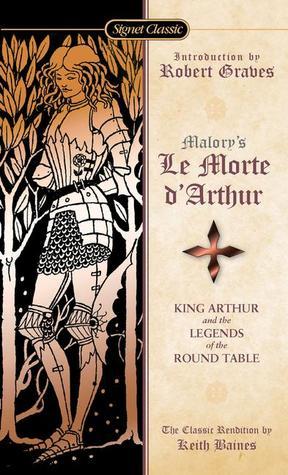
Thomas Malory’s Le Morte d’Arthur is less a single book than a long, capacious conversation with the Middle Ages: a compendium of romances, chronicles, saints’ lives and courtly songs that, in a single stroke, made the Arthurian past into England’s founding myth. It is at once encyclopedic and intimate — a work that gathers tradition into narrative shape while refusing the consolations of simple myth-making. Reading Malory is to stand inside a glittering, collapsing court: the Round Table still radiates light, but its seams and cracks are everywhere visible.
What the book does
At surface level it assembles the familiar sequence of adventures — the sword, the establishment of Arthur’s court, the Round Table, the knightly quests and tournaments, Lancelot’s triumphant prowess and fatal passion, the spiritual Grail quest, and finally the internecine violence that destroys the order Arthur founded. But the power of the book is not merely in the episodes themselves; it is in how the author stages their contradictions. The same pages that celebrate chivalric heroism repeatedly undercut it with betrayal, sexual transgression, and scenes of blunt, almost modern brutality. The narrative accumulates glory and guilt together until the two are indistinguishable.
Style and narrative technique
Malory’s prose — as transmitted to us through Caxton’s press — has a peculiar authority. It is plain where one might expect ornament, ceremonial where one might expect intimacy. The syntax often proceeds by parataxis: episode follows episode, each moment given its ceremonial space, and yet the repetitions and catalogues create an inexorable rhythm. This structural insistence works like a medieval fugue: motifs recur (sworn oaths, broken vows, the naming of enemies, the turning of steeds) and their repetition turns celebration into dirge.
Because Malory is compiling rather than inventing, his voice is at once that of a storyteller and that of an editor: he curates, selects, conflates sources, smooths inconsistencies and leaves certain tensions intentionally visible. The result is a text that feels both composed and raw — a mythic archive in which the editorial fingerprints themselves become part of the meaning.
Central tensions and themes
Two tensions dominate the work. First: the tension between sacred and secular. The Grail quest introduces a language of spiritual perfection that resists the martial code. The knights who succeed in the Grail mysteries are those whose inner purity aligns with divine purpose; this spiritual criterion sits uneasily beside the courtly measure of prowess, lineage and fame. Lancelot — consummate knight and consummate sinner — becomes the paradigmatic figure caught between these economies. His prowess sustains the court even as his passion dissolves it.
Second: the inevitability of decline. Malory’s Arthur is a founding figure whose reign contains its own obsolescence. The Round Table is a high experiment in communal rule; it is precisely the success of that experiment — the cultivation of fame, competition, and love — that creates the conditions of its ruin. Thus this compendium stages history as tragedy: noble actions bear noble consequences but also tragic unintended ones. Political idealism, erotic life, religious aspiration — all are implicated in the catastrophe.
Ethics, gender, and violence
A modern reader must reckon with the book’s medieval moral landscape. Women are often figures whose agency is expressed through motifs of desire or betrayal; Guinevere’s affair precipitates the civil war, for instance, and women’s sexualities are frequently the narrative fulcrum. At the same time, the author sometimes grants surprising complexity and agency to female characters, and the text’s moral ambivalence means those women refuse easy categorization.
Violence saturates the book: tournaments, executions, slaughter on the field. It never sentimentalizes bloodshed; instead, violence appears as both a social grammar and a moral question. The text invites us to admire heroic feats and simultaneously to recoil from their consequences — a moral tension that is arguably the heart of the work.
Why it still matters
Le Morte d’Arthur endures because it lives inside contradiction. It is a repository of heroic aspiration and ethical doubt; it invents national myth while preserving the unruly particularities of the stories that compose that myth. Its influence is visible everywhere — from Victorian retellings to twentieth-century reinventions — but its literary value is not reducible to influence. The book stages what any political community must ask itself: how to reconcile glory with justice, loyalty with truth, desire with duty. Those questions, posed in the idiom of knights and quests, still read like urgent contemporary problems.
A final judgment
Read as a romance, Le Morte d’Arthur is sumptuous and inexhaustible; read as a moral history, it is grimly instructive. The work’s greatest achievement is its ability to make myth feel historical and history feel mythical: the two registers collapse into one another, producing a narrative that both glorifies and indicts its heroes. For readers willing to sit with ambiguity — to admire and to mourn in equal measure — Malory offers a singularly rich meditation on power, fidelity and the cost of ideals.
Recommended for readers of medieval literature, anyone interested in the genealogy of English myth, and those who prize narratives that permit no easy consolation. For classroom use, pair Malory with contemporary criticism on chivalry and gender, and with selections from the Grail cycle to illuminate the text’s uneasy dialogue between the sacred and the worldly.
Discover more from The New Renaissance Mindset
Subscribe to get the latest posts sent to your email.
 The New Renaissance Mindset