
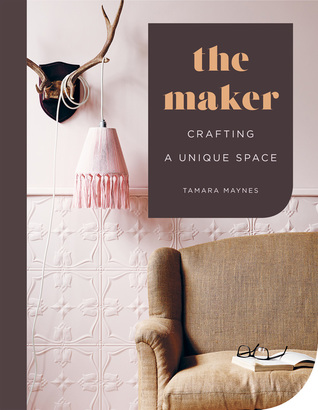
Tamara Maynes’ The Maker: Crafting a Unique Space is at once a manifesto for tactile domesticity and a practical handbook for anyone who wants their home to read like a lived, handcrafted archive. Maynes—who writes from the vantage of a practitioner—treats making not as a hobby but as a mode of seeing: an attentiveness to materials, scale, and the slow accumulation of objects that together produce atmosphere. The book’s formal logic is simple and persuasive: organize your attention around things you can make, and the space that holds them will inherit a coherence and intimacy otherwise lost to mass-produced décor.
Structurally, The Maker divides its inquiry into focused chapters—wall art, objects, textiles, ceramics, lighting, and furniture—each of which balances lush, documentary photography with short meditations on process and place. Maynes stages makers’ homes as case studies, letting interiors speak through artisans’ choices of colour, texture, and scale. This is not an abstract treatise on aesthetics: the book privileges the concrete. Each chapter closes with a simple, accessible DIY project and a short Q&A with an established maker, gestures that both democratize craft and point readers toward further study. These features gesture toward the book’s twin ambitions—to inspire and to teach.
As a work of cultural criticism, the author’s strongest move is her insistence that the act of making reconfigures our relationship to domestic space. Rather than seeing interiors as backdrops for curated consumption, she frames them as the cumulative record of labour and attention. The language she uses—often sensory and material—encourages a kind of phenomenology of the home: we respond to a room because its surfaces remember making. This argument is timely in an era when the “maker” label risks being co-opted by lifestyle marketing; Maynes largely resists mere trendiness by foregrounding process, imperfections, and the ethical pleasures of making things oneself.
Stylistically, the book is at its most persuasive when descriptive restraint lets images and artifacts do the rhetorical work. The photography is quiet but exacting: close-ups of woven joins, tile grout, and the irregular lip of a thrown bowl are given the same visual authority as whole-room shots. The layout privileges material detail in a way that mirrors the book’s thesis—attention to particulars yields a formal grammar for a whole interior. For readers with a background in art education or studio practice, these sections function like visual seminars; for the general reader, they offer an invitation to slow down and learn a new vocabulary for home.
Where the book is less satisfying—if one is inclined to critique—is in its occasional tendency toward aesthetic homogeneity. The homes featured are uniformly warm, textured, and craft-forward; the result is a persuasive aesthetic exemplar but a narrower social map of who gets to be a “maker” in contemporary discourse. A deeper ethnography of varied making practices—across socioeconomic contexts and global craft traditions—would have broadened the book’s claims about making as a universal remedy to placelessness. Similarly, readers looking for technical depth in any single craft will need to supplement these approachable DIYs with more focused manuals. These are not oversights so much as delimitations of scope.
The Maker succeeds as an elegy to material intelligence and as a pragmatic guide for people who want their houses to feel hand-shaped rather than showroom-flat. It is best read slowly, with a notebook and an impulse to try one small project immediately afterward. For designers, educators, and studio-practitioners—anyone invested in the pedagogies of making—it’s both inspiration and curricular. Published in 2017 and produced in collaboration with a reputable design publisher, it sits comfortably on the shelf between coffee-table beauty and practical craft primer.
If you approach The Maker with an appetite for texture, a tolerance for the unfinished edge, and a willingness to trade instant polish for the slow rewards of practice, Maynes will leave you seeing your rooms as material conversations—places to grow your hand and, through it, your sense of home.
Discover more from The New Renaissance Mindset
Subscribe to get the latest posts sent to your email.
 The New Renaissance Mindset