
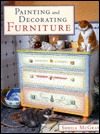
An attentive manual that thinks like a maker and reads like a quiet manifesto
Sheila McGraw’s Painting and Decorating Furniture presents itself at first glance as a pragmatic handbook: techniques, materials, step-by-step procedures. Beneath that useful surface, however, the book stages a subtler argument about how objects participate in our lives — about the ways finish, surface, and colour both conceal and reveal histories. McGraw writes like a practitioner who has spent long hours with wood dust in her hair and patience in her hands; she also writes like a careful observer of domestic aesthetics. The result is a volume that functions simultaneously as a how-to manual and a modestly persuasive aesthetic treatise.
Form and Pedagogy
McGraw organizes her material in a manner that privileges methodical learning. Chapters progress from basic materials and safety through preparatory work, painting techniques, and finally decorative finishes and hardware choices. This progression — from substrate to surface, from repair to ornament — mirrors the physical sequence of working on a piece and makes the book pedagogically satisfying. The author’s voice balances authority and encouragement: instructions are precise without being didactic, and troubleshooting sections treat mistakes as teachable moments rather than failures.
A notable pedagogical strength is it’s attention to scale and temperament. She writes for readers who range from complete beginners to experienced hobbyists: the book includes clear, accessible entry points (basic sanding and priming) while also offering advanced treatments (glazes, distressing, layered finishes) that reward repeat reading. The layout, where technique boxes and checklists punctuate longer essays, respects both quick reference and longer study.
On Technique and Taste
What distinguishes this book from a catalogue of recipes is McGraw’s persistent linking of technique to taste. Painting here is never merely cosmetic; it is a conscious act of translation — of a maker translating a mental image into pigment, texture, and wear. McGraw teaches how to choose a base-coat, but she also asks why you might choose milk paint over acrylic or why an artificially-patinated finish changes not only an object’s look but its conversational presence in a room.
This thematic through-line — the ethics and aesthetics of surface — elevates the book. It interrogates common binaries: restore versus refinish, preserve versus reinvent, mass-produced uniformity versus hand-wrought irregularity. Her preference, which becomes increasingly legible through the chapters, leans toward interventions that acknowledge an object’s past: finishes that reveal grain, distressing that looks accidental rather than theatrical, colour choices that harmonize rather than shout. These choices suggest an underlying philosophy close to what craft theorists call “respectful transformation”: altering an object so it may continue to live rather than erase its biography.
Visuals and Sensory Instruction
A manual of this kind lives or dies by its ability to convey tacit knowledge — the moments when hands must feel rather than measure. McGraw is attentive to sensory instruction. Descriptions of brushwork, drying times, and the tactile qualities of sanding are given with enough specificity to allow readers to anticipate outcomes. Where photographs and diagrams are deployed, they serve more as proof of concept than mere illustration; they anchor the reader’s expectations while leaving space for the inevitable improvisations of a real workshop.
If there is a limitation here, it is the perennial one for printed craft books: the gap between image and experience. No photograph can fully transmit the nuance of a brush-stroke or the way glaze catches light in motion. McGraw mitigates this by generous comparative language and by offering mitigation strategies — how to correct a brush mark, how to test colour in situ — that acknowledge the medium’s stubborn materiality.
Context and Cultural Resonance
Although primarily practical, the book gestures occasionally toward larger cultural currents: the democratization of design, the resurgence of maker culture, and the environmental stakes of finishes and adhesives. These discussions are brief but well-placed; they provide the reader with vocabulary for thinking about the politics of consumption and reuse without turning the manual into polemic.
McGraw’s work is best read against the recent wave of craft literature that emphasizes sustainability, upcycling, and the aesthetics of repair. She contributes to that discourse not by rallying slogans but by modelling a repair ethic in miniature: choose durable materials, favour finishes that are maintainable, and accept the aesthetic value of imperfection. For readers attuned to the contemporary desire for authenticity in domestic objects, this is quietly satisfying.
Critique and Limitations
The book’s restraint is generally a virtue, but at times it can feel too cautious. Readers seeking avant-garde surface experiments — radical coatings, experimental resins, or high-tech finishes — may find the palette conservative. Likewise, while McGraw touches on historical precedents for certain finishes, a deeper engagement with furniture history or cross-cultural surface treatments would have enriched the philosophical thread she begins to pull. A brief comparative study of period finishes or an appendix on sourcing heritage pigments, for instance, would have been welcome for the scholar-maker.
There are also moments when the “how” overshadows the “why” in ways that will please the technician but frustrate the theorist. The most interesting passages of the book are those that pause and reflect on the relationship between object and owner; a few more of these reflective pauses would have made the volume feel more rounded.
Painting and Decorating Furniture will serve admirably as a reliable, thoughtful guide for the committed home-maker and the early-career furniture restorer. McGraw’s writing combines the clear instruction of a seasoned teacher with the reflective curiosity of a careful maker. The book’s modest philosophical ambitions — to persuade readers that finish matters ethically and aesthetically — are achieved through steady, practical engagement rather than grand theorizing. For anyone who sees furniture as living material rather than inert commodity, this book offers both the tools and the language to act with care.
Recommended for: craft practitioners, design students, and readers curious about the intersection of technique and taste. Less suited for: experimental surface artists seeking cutting-edge materials or readers who want deep historical scholarship in place of hands-on instruction.
Discover more from The New Renaissance Mindset
Subscribe to get the latest posts sent to your email.
 The New Renaissance Mindset