
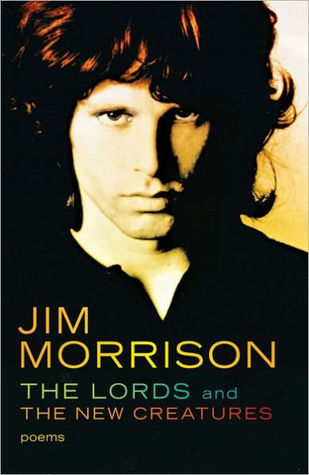
Jim Morrison’s The Lords and The New Creatures arrives at the reader like a recorded improvisation—uneven, urgent, and saturated with moments of startling clarity. Originally assembled from two short volumes first issued in the late 1960s, the text functions less as a conventional poetic sequence than as a series of charged tableaux: flashes of eroticism, ritual, cinematic observation, and declarative outrage that together map a young artist’s attempt to translate performance into page.
At the level of subject matter Morrison speaks in the idiom of his public persona—the Lizard King—yet the poems are not mere celebrity confessions. They are populated by the era’s obsessions: spectacle and surveillance, intoxication and transgression, the collision of sacred and profane. Morrison’s recurring motifs—cameras, screens, theatres—frame human bodies as images to be consumed or transfigured, and the book repeatedly stages the nervous economy between the one who looks and the one who is looked at. These themes (sex, fame, drugs, death) are not decorative; Morrison treats them as elements in an altar-piece of modernity.
Formally the poems are restless. Morrison cares less for polished closure than for velocity: elliptical lines, abrupt shifts of perspective, and a rhetoric that often feels spoken aloud rather than meditated on the page. This is both the collection’s strength and its limitation. When his diction narrows to precise, cinematic images—an eye that “clicks,” a body framed “like a film”—the poems acquire a tension and luminosity that justify repeated reading. At other moments, however, the work dissolves into adolescent invective or portent without the sustained symbolic architecture required for lasting myth-making. Critics and readers have long noted this cinematic preoccupation; Morrison’s poems frequently invoke the camera as both witness and god.
One of the clearest virtues of The Lords and The New Creatures is how it documents a particular performance of masculinity and spiritual aspiration at a cultural inflection point. Morrison is obsessed with transmutation—how language, sex, and spectacle promise (or fail) to transform the self—and he borrows liberally from Surrealist or Dionysian registers to do so. This borrowings sometimes feel protean, as when classical allusion rubs against street slang, and at other times they feel derivative: the poet is still apprenticing himself to a mythic vocabulary he has not yet fully owned. For readers who encounter the collection knowing Morrison through his music, there is an uncanny continuity: the poems often read like lyrics torn free of melody and allowed to crash into associative, often mythic imagery.
Where the book most rewards a close-read is in its quieter passages—moments when the writer slows enough to let an image accrue meaning rather than simply shock. In these lines the poet’s ear for cadence and his capacity for concentrated, eroticized vision shine: the metaphors feel tactile, the tone intimate. Yet the very promise of intimacy is undercut by performance: Morrison’s speech habitually assumes an elevated stance, a prophetic or confrontational register that can estrange as often as it invites. That oscillation between confession and proclamation is the book’s abidingly interesting contradiction.
As a piece of literary history, The Lords and The New Creatures is also valuable for what it reveals about the late 1960s—its paranoid modernity, its hunger for transgression, and its fascination with media. It is not a mature, self-contained lyric achievement on the order of contemporaneous poets who mastered compression and discipline; rather, it is a raw, volatile artifact from a figure who was primarily a performer. Read on its own terms, however, the collection offers a distinctive, occasionally brilliant voice: an artist testing the edges of language and celebrity, trying to make a self through images loud enough to be heard over the amplifier.
Approach this book as you would a live recording—attend to the energy, savour the moments of clarity, and be patient with the rough edges. For fans of Morrison’s music the book amplifies the lyrical obsessions heard in The Doors; for the literary reader it offers a compelling, if flawed, example of performance-poetry at the axis of counterculture and mass spectacle.
Discover more from The New Renaissance Mindset
Subscribe to get the latest posts sent to your email.
 The New Renaissance Mindset