
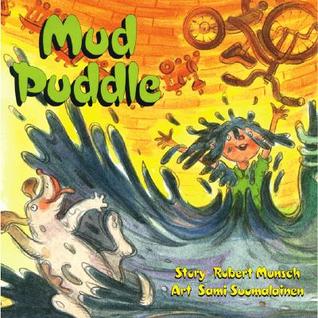
Robert Munsch’s Mud Puddle reads like a tiny masterpiece of oral storytelling compressed into thirty-two pages: brisk, comic, cumulative, and animated by a single, delightfully absurd conceit — a mud puddle that repeatedly “jumps on” a child and gets her “completely all over muddy.” The story began as a tale told in a nursery school and became the writer’s first printed book, which helps explain why the text still has the immediacy, rhythm, and performative repetition of a story meant to be spoken aloud.
At surface level the plot is pure slapstick: Jule Ann (named after a real child who inspired Munsch) ventures outside in clean clothes and is pounced upon by mud; she’s scrubbed clean, goes out again, and is pounced upon again — an escalation that children find irresistible because it maps onto the pleasure of transgression and the bodily comedy of being messy. The pattern culminates in a small, clever reversal: Jule Ann doesn’t merely learn to avoid the puddle or obey an adult prohibition; she invents a solution that is equal parts pragmatic and mischievous. That resolution—simple, tactile, slightly stinky—recasts the child not as a passive recipient of parental discipline but as the competent agent of her own story.
Stylistically, Mud Puddle is a study in economy and escalation. Its diction is immediate and colloquial; repetition functions both as comic punctuation and as a performance device that invites audience participation. The story’s repeated beats create a sense of inevitability that allows the eventual subversion (Jule Ann’s victory) to feel earned and rapturously satisfying. In performance, those repeating lines become opportunities for timing and voice — why the text works as well in an adult’s telling as it does on the page for a first reader.
Illustration plays a central role in how the story is received. Various editions have been paired with different artists (early versions with Sami Suomalainen; later popular editions with Dušan Petričić), and the illustrations amplify Munsch’s carnivalesque energy. Petričić’s work in particular renders the mud as an almost sentient, tarry blob with scribbled textures and frantic motion lines — a visual partner to the oral exaggeration in the text. That combination of rambunctious line work and exaggerated expression heightens the grotesque humour without becoming threatening; the child’s agency remains the story’s moral anchor even as the pictures luxuriate in mess.
Beneath the laugh-out-loud surface, Mud Puddle stages a gentle but powerful critique of adult anxieties about cleanliness and control. The narrative continually juxtaposes domestic order (clean clothes, parental cleanings) with the outdoor world’s irreducible chaos, and Munsch’s framing privileges the latter. Jule Ann is not punished for getting dirty; she is scrubbed and then set loose again — and ultimately, she solves the problem on her own terms. The book therefore models a particular pedagogy: children are curious investigators of their environment, and problem-solving often looks like trial-and-error, play, and ingenuity rather than docile conformity.
For educators and parents the book offers multiple teaching hooks: performative reading that encourages oral participation, predictable repetition that supports early reading skills, and a subtle social lesson about resilience and agency. At the same time, it refuses to moralize; the book’s ethical stance is enacted through Jule Ann’s competence rather than through scolding or a didactic finale. That restraint is part of what keeps Mud Puddle fresh for readers decades after its first telling.
In short, Mud Puddle is small but sturdy: a primer of physical comedy, a showcase for oral-form techniques, and a quietly progressive text about children’s resourcefulness. It remains one of Munsch’s most telling early pieces because it crystallizes the features that make his work enduring — the spoken cadence, the child-centred perspective, and the conviction that children are, in their own messy way, the architects of their learning. For storytime, for first readers, and for anyone who remembers the particular indignity and joy of being unexpectedly muddy, Mud Puddle still delivers a full, exuberant laugh.
Recommended for: ages 4–8; ideal for read-aloud sessions and lessons about cause–effect, sequencing, and invention.
Discover more from The New Renaissance Mindset
Subscribe to get the latest posts sent to your email.
 The New Renaissance Mindset