
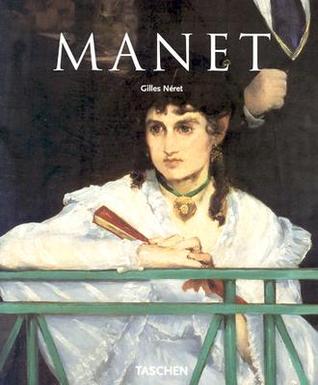
Gilles Néret’s compact monograph—published in Taschen’s widely circulated Basic Art series under the title Édouard Manet: 1832–1883 — The First of the Moderns—functions less as a revisionist manifesto than as a lucid, image-forward argument for a familiar claim: that Manet inaugurates modern painting by refusing the consolations of academic narrative and classical imitation.
The central proposition is straightforward and rhetorically precise: Manet is “first” not by chronological luck but by method. The book traces how Manet’s painterly decisions—flattened pictorial space, abrupt brushwork, and the frank modernity of his subjects—undermined the optical illusions and moralizing narratives prized by the Salon yet opened a new, self-conscious language for representing modern life. Néret marshals the usual exemplars—Le Déjeuner sur l’herbe, Olympia, the cafés and bar scenes—not as curiosities but as way stations in a career that consistently interrogates the relation between representation and modern experience.
What distinguishes this book for the general reader and the teaching room is its discipline of selection. At roughly a hundred pages, the volume is spare: short, punchy essays accompany a generous array of plates so that the visual argument often speaks louder than the prose. This is precisely the book’s virtue and its limitation. For readers encountering Manet for the first time, the reproductions—carefully chosen and well printed—render the painter’s radical facture tactile: you can see the economy of colour, the deliberate “patches” of light and shadow, the insistently modern gaze of his sitters. For specialists, however, it’s synthetic moves sometimes read as declarative rather than interrogative; there is little archival excavation or engagement with recent historiographical disputes about Manet’s politics, patronage networks, or the shifting reception of his work across Europe.
Some avid readers will notice how the book treats Manet’s images as texts—compressed narratives that resist linear reading. Néret’s prose tends toward appositive, occasionally aphoristic statements: the painter’s “provocations” are named and then set beside formal descriptions. This rhetorical economy helps the volume move briskly but sometimes short-circuits the deeper cultural tensions embedded in works like Olympia—a painting that, as the. author reminds us, unsettled contemporaries because it refused the symbolic alibi of myth and instead staged a modern subject’s transactional visibility. In a brief, supple paragraph he outlines the scandal and its stakes; the reader is left to supply the larger social and economic contexts.
Where the book performs best is in calibration: the balance between close looking and art-historical claim. It resists the twin temptations of hagiography and iconoclasm. Manet emerges in these pages neither simply as a lonely genius nor as an opportunistic provocateur but as a painter who repeatedly tested the limits of painting itself—its ability to flatter, to narrate, to disguise. The book’s layout—image beside concise commentary—models an interpretive practice: see first, then explain; let the picture unsettle the sentence. For classroom use this format is exemplary.
A fair scholarly critique would press Néret further on three fronts. First, on method: the book would profit from a clearer account of its critical inheritances—how much he depends on the older narrative that aligns Manet with Courbet and Impressionism, and where he diverges. Second, on social context: the volume gestures at Parisian modernity but seldom unpacks the press controversies, exhibition politics, or market pressures that shaped Manet’s choices. Third, on nuance: the “first of the moderns” formulation is rhetorically satisfying but flattens a more complicated genealogical picture in which multiple artists and publics participate in the making of modernity. The book is thus best read as an elegantly argued prologue to deeper study rather than as an endpoint.
“Manet…” is a concise, beautiful primer—an image-rich, readable guide that argues persuasively for Manet’s primacy in the modern canon while inviting readers to follow up with more capacious scholarship. For readers who want to feel Manet’s brushwork and grasp the outlines of his contribution in a single sitting, this book is hard to beat. For those seeking archival depth or historiographical revision, Néret’s volume is a brisk, authoritative portal rather than a final word. Recommended for undergraduates, museum-goers, and any reader who prefers looking first and theorizing second.
Discover more from The New Renaissance Mindset
Subscribe to get the latest posts sent to your email.
 The New Renaissance Mindset