
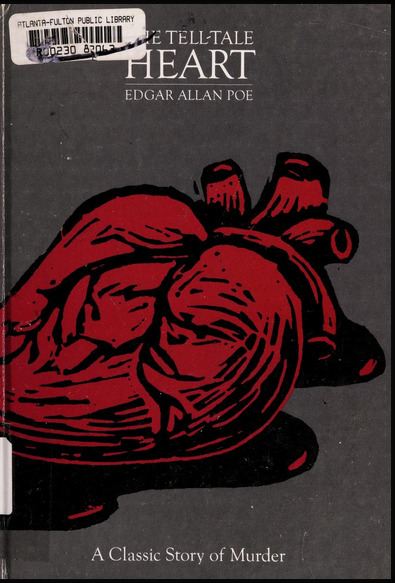
Edgar Allan Poe’s The Tell-Tale Heart is a study in compression: a few pages of prose that map, with surgical precision, the anatomy of guilt. Unlike long Gothic romances that luxuriate in setting and backstory, Poe offers a single, claustrophobic motion — the narrator’s descent from confident rationalization into seizure-like confession — and trusts that motion to carry the reader through the whole moral landscape. The result is less a plot than a pressure chamber in which the self is slowly liquefied.
At the surface the story is simple: an unnamed narrator insists on his sanity while describing the murder of an old man, killed not for motive of gain or passion but because of his “vulture-eye.” Poe transforms that apparent triviality into an engine of meaning. The narrator’s repeated insistences on reason (“You fancy me mad. Madmen know nothing.”) do not reassure so much as amplify our sense of instability; the work’s rhetorical strategy is to let language itself demonstrate the breakdown it purports to deny.
Form and technique are where the story does its most interesting work. The first-person present voice is fevered and performative — we are listening to a speech act that doubles as self-exposure. Poe’s sentences, staccato and cyclical, mimic the narrator’s pulse and breathing; repetition functions like a drumbeat, luring the reader into the same hall of mirrors where the narrator wanders. This is a story of sound as much as of sight: the imagined “sound” of the beating heart becomes a motif that Poe escalates from interior sensation to a quasi-audible reality, collapsing the boundary between perception and hallucination.
Thematically, The Tell-Tale Heart stages a confrontation between the legal and the moral, between the narrator’s desire for control and the body’s capacity for embodied truth. The narrator believes he can excise the moral problem by removing the physical object of fixation — the old man’s eye — but what proves indelible is the psychological trace. The heart, in Poe’s economy, is not merely organ but conscience: its beat is the insistence of what cannot be repressed. When the murderer finally confesses, it is not to a visible witness but to the imagined amplification of his own inner law.
Poe’s treatment of madness is neither pathologizing in a clinical sense nor purely allegorical. Madness here is a rhetorical performance and a cognitive collapse: the narrator’s language tries to mask terror with logic, and the more he argues, the more his argument reveals. This reading complicates a simple diagnostic label; the story asks whether sanity is primarily a matter of perception, of social performance, or of the integrity of the self’s inner witness.
There is also a careful aesthetic economy at play. The sparse setting — a single room, one night, the act of entombment in a floorboard — focuses attention on the interplay of micro-details. Poe’s gothicism is pared back to essentials: darkness, sound, the creeping hand of the clock. In so doing he creates an intimacy that is more unsettling than spectacle; we are not spectators at a crime, we are auditors of a confession, and Poe makes us complicit.
The Tell-Tale Heart endures because it models a kind of literary minimalism that remains capacious: a short narrative that stages universal questions about conscience, self-deception, and the limits of language. It is a reminder that the most profound terrors often arrive not from monstrous others but from the rumour of a heart within us that keeps time when we most desire silence. For readers and writers alike, the story is a lesson in how voice, rhythm, and formal restraint can turn psychological nuance into dramatic inevitability.
Discover more from The New Renaissance Mindset
Subscribe to get the latest posts sent to your email.
 The New Renaissance Mindset