
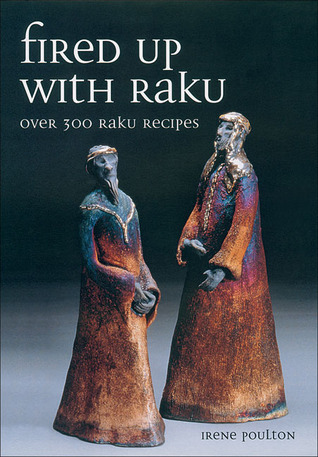
Irene Poulton’s Fired Up with Raku: Over 300 Raku Recipes reads, at first glance, like a practical compendium; read closely, it reveals itself as a meditation on the paradox at the heart of raku work — the persistent human desire to name, measure, and reproduce a process whose aesthetic power depends on chance. She gives the ceramicist a vast repertory of formulas and technical permutations, but she also stages, between lists of ingredients and firing notes, a quiet argument about what mastery in the ceramic arts actually comprises.
Form and Argument
The book’s formal conceit is straightforward: recipes organized for clarity and use. That utilitarian scaffolding, however, is where the author’s literary sensibility pays off. Rather than presenting recipes as sterile commands, she frames them as experiments whose outcomes are conversational rather than deterministic. The prose moves with the calm authority of a practiced teacher — economical, precise, but not devoid of an awareness about contingency. The collection’s scale (three hundred-plus recipes) functions rhetorically: it both reassures the reader that there is method to be learned and makes a contrapuntal point about variation — that richness in surface and glaze is generated through disciplined iteration rather than a single “secret” formula.
Technique as Language
The book treats glaze recipes and firing schedules as a kind of lexicon. In this metaphor the ceramicist is less a mechanic than a reader and composer: glazes are words, firings are sentences in which the kiln, atmosphere, and removal timing supply the punctuation. This linguistic framing lets her attend to voice — and to the ways a slight alteration (an extra tablespoon of kaolin, a two-minute earlier removal) shifts emphasis and tone. The book therefore functions for practitioners as both cookbook and grammar; for the thoughtful reader it invites reflection on how technique produces meaning in an art historically associated with spontaneity.
Chance, Ritual, and Modern Raku
One of the book’s most interesting implicit arguments concerns the tension between raku’s origins — associated with tea ceremony, austerity, and a refined aesthetic of imperfection — and its contemporary, often flamboyant, western practice. It honours raku’s historical lineage without cloistering it in nostalgia. The recipes and commentary acknowledge the ceremonial roots: the humility of pared-down surfaces, the embrace of crackle and scorch as evidence of process. Yet it also embraces the modern studio’s appetite for experimentation: post-firing reduction, smoke patterns, and surface manipulation. The result is not a schizophrenic stance but a nuanced negotiation: raku is shown as a living technique that yields different kinds of beauty depending on the questions the maker brings to the kiln.
Pedagogy and Audience
This book is plainly intended primarily for working ceramists — students, studio potters, and teachers — and it succeeds admirably there. The recipes are granular enough to be replicated, and the sequencing from basic to adventurous recipes scaffolds learning. At the same time, the book has value for a broader audience: readers interested in material culture, ritual, and the aesthetics of imperfection will find in Poulton’s measured commentary an accessible entry into what can otherwise read as an opaque technical practice.
If there is a limitation, it is the inevitable one faced by any compendium of recipes: by cataloguing so comprehensively, the book sometimes risks making raku appear more like a chemistry set than a performative ritual. The danger is structural: how to present replicable knowledge while also reminding readers constantly that the kiln — like any collaborator — will always surprise. It mitigates this with marginal notes and occasional asides that foreground unpredictability, but readers inclined toward romantic notions of “authentic raku” may find that its empirical thoroughness deflates myth rather than restoring it.
Style and Rhetoric
Stylistically the book privileges clarity over ornament. Poulton’s sentences are lean; her metaphors, when they appear, serve to illuminate rather than decorate. This discipline is an asset: it makes the technical content legible without sacrificing the book’s quieter philosophical impulses. When she does step back from the bench to reflect — on the ethics of material sourcing, or on safety protocols — her tone becomes conversationally urgent in a way that reminds the reader that craft happens within social and environmental contexts.
What the Book Offers
Fired Up with Raku is both a manual and a small philosophy of making. It promises, and largely delivers, a reliable set of starting points for a wide range of aesthetic outcomes while repeatedly asserting the centrality of experiment and response. For teachers it is a treasure trove of reproducible exercises; for advanced practitioners it is a reference volume that legitimizes and organizes years of studio intuition; for the reflective reader it offers a compact ethics of material practice: respect for tradition married to an openness to the accident.
Poulton’s work will not convert those who seek a single, miraculous glaze; rather, it invites a different conversion — toward patience, iteration, and a reverence for process. In that sense, the book performs the same lesson that raku itself teaches: beauty often arrives at the edge of control, where the maker’s hand meets the kiln’s temper.
Discover more from The New Renaissance Mindset
Subscribe to get the latest posts sent to your email.
 The New Renaissance Mindset