
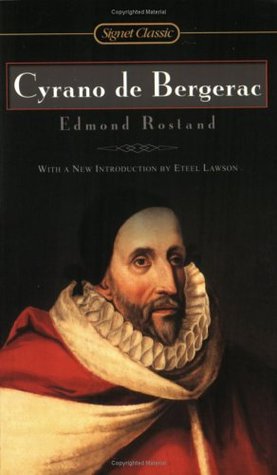
Edmond Rostand’s Cyrano de Bergerac is at once a theatrical confection and a sharply worked tragedy of language. Written for the theatre — and written to be heard — the play glories in the sound of words: the quick thrusts of wit, the rolled cadence of heroic verse, the extravagant pyrotechnics of rhetoric. Yet beneath its laughs and bravura speeches there is a melancholic architecture: a man whose highest gift (speech) becomes the instrument of his self-erasure.
What the play does
Rostand stages the story of Cyrano — soldier, poet, duelist, and, famously, the owner of an enormous nose — who loves Roxane but, convinced that his monstrous appearance makes him unworthy, helps another man, Christian, win her heart by supplying the language Christian lacks. The plot moves through comic episodes of bravado (the theatre scene, the sword fights), intimate feats of imagination (the balcony/letter episodes), and finally into a muted, elegiac dénouement at the convent where Cyrano dies known to the reader but only gradually revealed to Roxane.
Language and form: when the medium is also the message
Cyrano is quintessentially theatrical: it is constructed to exploit the voices of actors and the immediacy of verse drama. The playwright writes in a highly rhetorical mode, often using the alexandrine line (the classical twelve-syllable French verse) and rhyme schemes that give the text a musical, bounded quality. The result is a stylistic double-bind that mirrors the protagonist’s psychology: language is both armour and prison.
Critically, Rostand makes language into Cyrano’s heroic medium. Its protagonist’s eloquence is martial — metaphors are thrust like foils; epigrams land like blows. Yet that same eloquence can be turned inward to exquisite tenderness when Cyrano composes the letters to Roxane. It is by voice, not sight, that love is ultimately made — and this is the play’s central irony. The most articulate man is rendered mute in the one domain where he most needs to speak for himself.
Masks, honour, and the economics of self-presentation
Cyrano’s nose functions as the play’s central emblem: grotesque, comic, grotesquely comic — and then finally tragic. It externalizes the social economy of value and appearance. The author interrogates how honour and reputation are produced in a performative society: duels, speeches, letters, and theatrical displays all compete to define who a man is. Cyrano performs an exaggerated ideal of chivalric honour — he defends a friend’s dignity on the battlefield, challenges a nobleman’s vanity with wit, refuses to stoop to hypocrisy — yet this same scruple blocks him from claiming the simple, vulnerable goods of personal happiness.
Roxane is more than a prize: she is a mirror and a moral gauge. She prizes words and wit as much as beauty; this makes her both the ideal object and an active moral agent in the drama. Christian’s physical attractiveness but verbal poverty force the play to stage a triangular economy — flesh, speech, and ideal — in which authenticity and illusion are constantly traded.
Irony and theatrical ethics
The play’s irony is delicate and pervasive. It asks whether heroic integrity is compatible with self-deception. Cyrano’s greatest acts of nobility — the letters he writes for Christian — are also acts of private violence against himself. The play does not moralize simplistically: it admires Cyrano’s courage while lamenting the vanity that prevents him from being loved as he is. Moreover, it is aware of artifice; the play frequently winks at its own theatricality (theatrical scenes staged within the theatre), inviting the audience to admire skill even as it mourns its costs.
Staging, comedy, and the ache beneath the smile
On stage, Cyrano is superbly generative. Its set pieces — the Roxane balcony, the battle at Arras, the comic theatre sequence — allow for a mixture of spectacle and intimacy. The scaffolded structure, alternating public display with private pain, sustains the tragic momentum. The play’s final scene, where Roxane recognizes the voice of the man she loved only through his dying confession, converts rhetoric into revelation; the language that once masked Cyrano’s heart finally exposes it.
Legacy and the play’s enduring power
Rostand’s play is often read as a late-nineteenth-century revival of romantic heroism, a corrective to the ironies of naturalism. Yet its emotional intelligence keeps it vital. At its core Cyrano de Bergerac is a meditation on the ethics of speech: who may speak, what speech can do, and what is lost when eloquence substitutes for courage in love. That paradox — eloquent selflessness that becomes a form of self-punishment — is as modern as it is classical.
Seen as both entertainment and philosophical parable, Cyrano de Bergerac withstands close reading because its pleasures are the very materials of its argument. Rostand gives us laughter and lyric, swordplay and a pain that does not ease into sentimentality. The play remains a striking study of paradox: the man who can command words cannot command the single word he most needs — “I.” For readers and viewers who value language as action, Rostand’s masterpiece offers the rare theatrical experience in which style and substance are not merely married but tragically interdependent.
Cyrano’s Monologue describing his own nose
THE VISCOUNT: No one? But wait! I’ll treat him to. . .one of my quips!. . .
See here!. . . (He goes up to Cyrano, who is watching him, and with a conceited air): Sir, your nose is. . .hmm. . .it is. . .very big!
CYRANO (gravely): Very!
THE VISCOUNT (laughing): Ha!
CYRANO (imperturbably): Is that all?. . .
THE VISCOUNT: What do you mean?
CYRANO: Ah no! young blade! That was a trifle short!
You might have said at least a hundred things
By varying the tone. . .like this, suppose,. . .
Aggressive: ‘Sir, if I had such a nose I’d amputate it!’
Friendly: ‘When you sup It must annoy you, dipping in your cup;
You need a drinking-bowl of special shape!’
Descriptive: ”Tis a rock!. . .a peak!. . .a cape! —
A cape, forsooth! ‘Tis a peninsular!’
Curious: ‘How serves that oblong capsular?
For scissor-sheath? Or pot to hold your ink?’
Gracious: ‘You love the little birds, I think?
I see you’ve managed with a fond research
To find their tiny claws a roomy perch!’
Truculent: ‘When you smoke your pipe. . .suppose
That the tobacco-smoke spouts from your nose–
Do not the neighbors, as the fumes rise higher,
Cry terror-struck: “The chimney is afire”?’
Considerate: ‘Take care,. . .your head bowed low
By such a weight. . .lest head o’er heels you go!’
Tender: ‘Pray get a small umbrella made,
Lest its bright color in the sun should fade!’
Pedantic: ‘That beast Aristophanes Names Hippocamelelephantoles
Must have possessed just such a solid lump
Of flesh and bone, beneath his forehead’s bump!’
Cavalier: ‘The last fashion, friend, that hook?
To hang your hat on? ‘Tis a useful crook!’
Emphatic: ‘No wind, O majestic nose,
Can give THEE cold!–save when the mistral blows!’
Dramatic: ‘When it bleeds, what a Red Sea!’
Admiring: ‘Sign for a perfumery!’
Lyric: ‘Is this a conch?. . .a Triton you?’
Simple: ‘When is the monument on view?’
Rustic: ‘That thing a nose? Marry-come-up!
‘Tis a dwarf pumpkin, or a prize turnip!’
Military: ‘Point against cavalry!’
Practical: ‘Put it in a lottery!
Assuredly ‘twould be the biggest prize!’
Or. . .parodying Pyramus’ sighs. . .
‘Behold the nose that mars the harmony
Of its master’s phiz! blushing its treachery!’
–Such, my dear sir, is what you might have said,
Had you of wit or letters the least jot:
But, O most lamentable man!–of wit
You never had an atom, and of letters
You have three letters only!–they spell Ass!
And–had you had the necessary wit,
To serve me all the pleasantries I quote
Before this noble audience. . .e’en so,
You would not have been let to utter one–
Nay, not the half or quarter of such jest!
I take them from myself all in good part,
But not from any other man that breathes!
DE GUICHE (trying to draw away the dismayed viscount):
Come away, Viscount!
THE VISCOUNT (choking with rage): Hear his arrogance!
A country lout who. . .who. . .has got no gloves!
Who goes out without sleeve-knots, ribbons, lace!
CYRANO: True; all my elegances are within.
I do not prank myself out, puppy-like;
My toilet is more thorough, if less gay;
I would not sally forth–a half-washed-out
Affront upon my cheek–a conscience
Yellow-eyed, bilious, from its sodden sleep,
A ruffled honor,. . .scruples grimed and dull!
I show no bravery of shining gems.
Truth, Independence, are my fluttering plumes.
‘Tis not my form I lace to make me slim,
But brace my soul with efforts as with stays,
Covered with exploits, not with ribbon-knots,
My spirit bristling high like your mustaches,
I, traversing the crowds and chattering groups
Make Truth ring bravely out like a clash of spurs!
Discover more from The New Renaissance Mindset
Subscribe to get the latest posts sent to your email.
 The New Renaissance Mindset