
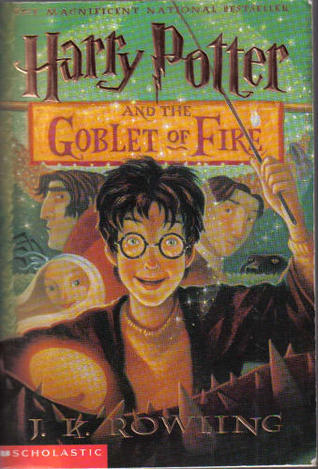
Harry Potter and the Goblet of Fire performs a decisive tonal and structural shift in J.K. Rowling’s series: what began as a tightly localized tale of a magical boy on the margins of domestic unease becomes in Book Four an expansive ritual narrative that stages adolescence, institutional failure, and the return of political terror. It keeps the pleasures of childhood fantasy — the vivid set-pieces, the comic grotesque adults, the ingenious rules of magic — but refocuses them through an initiation plot whose stakes grow from the personal to the civic. The result is a novel that is both transitional and ambitious: a coming-of-age story that simultaneously rewrites the moral geography of the wizarding world.
Structurally, the novel is built around the Triwizard Tournament, an inherited folkloric form — a contest of trials, tests, and rites of passage — transplanted into a modern boarding-school setting. This grafting produces a hybrid: part quest-romance, part detective story, part political thriller. The tournament’s formal constraints allow it to dramatize different registers of narrative tension (puzzle, hazard, spectacle) while the persistence of bureaucratic institutions (the Ministry of Magic, Hogwarts’ governors) introduces a second, less heroic register — the administrative — that complicates the heroics on display. The novel thus refuses to offer a pure victory narrative; heroism is complicated by incompetence, misjudgment, and theatrical deception.
At the heart of the book is adolescence conceived not only as bodily growth but as an ethical apprenticeship in publicity, shame, and responsibility. Harry’s selection for the tournament (an anomalous event that he neither sought nor understood) places him under the extraordinary gaze of the magical public. Rowling interrogates how young people are forged in and against public scrutiny: fame and notoriety become social technologies that shape identity. The novel’s recurring spectacles — the Yule Ball, the tasks, the press coverage — ask whether courage is intrinsic or performative. Importantly, Rowling shows that spectacle can be weaponized: the Goblet itself, the metamorphoses, and the climactic resurrection scene convert performance into a means of political theatre.
Goblet of Fire is when the series’ political subtext sharpens into overt critique. The Ministry of Magic’s response to events — from denial to internecine posturing — models the dangers of state obfuscation and captured institutions. This chapter stages an epistemological crisis: who speaks truth to power, and how is truth dismissed or manufactured? The Ministry’s fumbling reifies the novel’s central moral claim: that moral clarity requires not merely courage but vigilance and civic literacy. The Ministry’s failures also set the stage for the later political arc of the series, making this book less an isolated adventure than a hinge upon which public life turns darker.
The book deepens its principal characters while complicating easy moral binaries. Hermione grows into a political actor (her campaigning for house-elves prefigures later activism), Ron struggles with envy and self-worth in an honest, often painfully comic register, and Dumbledore’s authority begins to show fissures of secrecy and strategic reticence. New characters—Mad-Eye Moody (and his duplicity), the cunning Rita Skeeter, the politicized Kingsley/Ministerial figures—are introduced as embodiments of narrative functions: mentor, parasite, conscience. Most striking is Rowling’s handling of antagonism: Voldemort’s return is not merely an externalization of evil; it exposes complicity, cowardice, and the limits of adult protection. The book refuses to shelter its adolescent protagonists from complex ethical landscapes.
Rowling’s prose here balances exposition and momentum with a stage-director’s clarity. The novel’s long set pieces (the tasks, the graveyard scene) are rendered in sustained, cinematic description that rarely derails the authorial voice. At the same time, her humour — linguistic play, grotesque caricature, and satirical skewer of pretension — remains, offsetting darker moments and preserving accessibility. The pacing is deliberately episodic: each task functions as a self-contained trial but also as a mirror for character growth and thematic intensification.
One might note that the book occasionally strains under the weight of its multiple ambitions. Some expository passages slow the narrative, and certain plot conveniences (the timing of the Cup, the narrative usefulness of some secondary characters) feel engineered. There is also a didactic edge to some political commentary that flirts with heavy-handedness. Yet these are quibbles against the novel’s larger achievements: its capacity to expand a children’s series into a sustained moral-political saga without losing narrative verve or emotional immediacy.
Goblet of Fire is the book where Rowling’s series shifts from the parochial to the public, from schoolroom mystery to state-level crisis. It turns adolescence into political theatre and shows how rites of passage are never purely private. For readers and scholars alike, the novel offers fertile ground: a text where genre hybrids elucidate character formation, and where spectacle reveals the collapse and potential of civic institutions. It is at once the most entertaining and the most consequential volume to this point — a bravura fusion of mythic form, institutional critique, and the raw business of growing up.
Discover more from The New Renaissance Mindset
Subscribe to get the latest posts sent to your email.
 The New Renaissance Mindset