
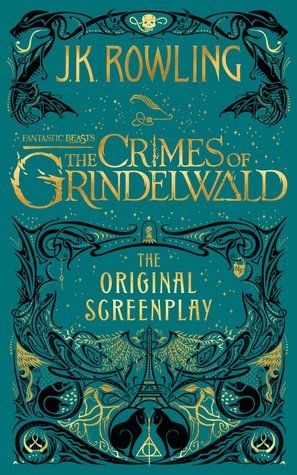
J.K. Rowling’s The Crimes of Grindelwald is an odd chimera: part myth-making, part franchise machinery, and part apologue about power, identity, and the price of certainty. Read as a literary object rather than as a piece of cinematic tie-in, the screenplay invites a distinct kind of scrutiny — one that must account for its hybrid form (dialogue-heavy, action-oriented, with stage directions in place of interiority) and for its place inside a sprawling trans-media narrative. In that light the work is often more intriguing than successful: ambitious in its thematic reach, uneven in execution, and richly suggestive even when it disappoints.
Rowling’s instincts as a world-builder remain sharply in evidence. The screenplay is, at its best, an inventory of atmospheric set pieces and small expository gestures that cumulatively extend the moral and historical architecture of the Wizarding World. She is attentive to ritual — to the ways that spell-casting, public spectacle, and myth-work function as forms of political theatre — and she uses the fantastical register to stage debates about legitimacy and belonging. The titular antagonist, Grindelwald, is not merely a villain to be vanquished but a charismatic ideologue whose rhetoric (and the reaction it produces) forces other characters — and the reader/spectator — to take stock of what they owe to law, loyalty, and love.
This thematic thread — the seduction of absolutism — is the screenplay’s strongest contribution. Rowling frames Grindelwald’s project as a historical movement with social and psychological depth: his appeal rests on a mixture of grievance, charisma, and rhetorical clarity. Against him, characters such as Dumbledore and Newt serve different counter-arguments. Dumbledore embodies the weight of ethical ambivalence and regret; Newt, by contrast, continues to insist on attachment to the particular (animals, friends, small kindnesses) as a political stance. That Rowling stages an ideological contest rather than a mere good-versus-evil duel lends the work a seriousness that rewards close reading.
Yet the screenplay form both enables and constrains Rowling. Screenplays must externalize; interiority is signalled by action and line rather than paragraph-long reflection. The result is a narrative that often substitutes portentous dialogue and tableau for psychological subtlety. Several character arcs feel compressed or underwritten: motivations that a novel might unfurl over pages are sometimes rendered as shorthand declarations or sudden reversals. The sprawling ensemble — returning favorites alongside new figures — creates a crowding effect. With so many players on the board, emotional investments sometimes fail to cohere; we are told that a relationship is fraught rather than shown why it is. That compression is especially felt in moments that demand ethical specificity: moral choices are announced, but their subjective weight is not always earned.
Rowling’s prose — pared and cinematic here — oscillates between lyric and functional. Her dialogue can be nimble and revealing, but occasionally tips into the programmatic: speeches that exist to transmit back-story or to crystallize themes rather than to sound like speech. There is nevertheless a craft at work in the screenplay’s images. Rowling composes sequences that dramatize memory and historical trauma, and she repeatedly returns to motifs of identity — bloodlines, names, and the ways public narratives erase or preserve individuals. These motifs give the script a mythic cadence: it wants to be read in relation to the earlier Potter texts as part of a much longer cultural conversation about inheritance, nationhood, and the ethics of remembering.
Critically, the screenplay invites a conversation about ethics of spectacle. The magical set pieces — lavish and inventive — function as both spectacle and argument. Rowling uses spectacle to show the stakes of political theatre (how spectacle can consolidate followers, intimidate opponents, and rewrite history). Yet those very scenes sometimes overwhelm the quieter moral dilemmas at the core; the eye is dazzled even when the heart should be asked to reckon. This tension — between dazzling world building and attenuated interior life — is the work’s abiding strength and its recurrent frustration.
For readers interested in trans-media storytelling, the screenplay is a fascinating specimen. It shows how a single author negotiates seriality: the pressure to expand a universe, to seed future episodes, and to balance fan expectations with narrative surprises. For literary scholars, it offers a prize: a text that negotiates genre (screenplay + fantasy + political fable), uses mythic structures to interrogate modernity, and stages the discursive labor by which a charismatic leader remakes moral categories.
The Crimes of Grindelwald is an ambitious, sometimes untidy, often provocative addition to Rowling’s corpus. It is richest when it narrows its focus — when it allows questions of persuasion, regret, and loyalty to play out in small, human gestures — and less convincing when it expands into spectacle without securing the interior logic of its characters. As a work for analysis it rewards patient readers: it is a text of ideas disguised as blockbuster: containing a politics of enchantment that is, at once, seductive and alarmingly recognizable.
Discover more from The New Renaissance Mindset
Subscribe to get the latest posts sent to your email.
 The New Renaissance Mindset