
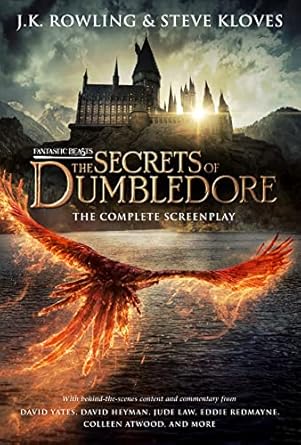
J. K. Rowling’s name on a spine still summons an array of readerly habits: eager return to a familiar lexicon of enchantments, a hunger for mythic scaffolding, and a readiness to re-enter a world where moral categories are usually luminous and legible. The published Complete Screenplay for The Secrets of Dumbledore, co-credited to screenwriter Steve Kloves and issued as a companion object to David Yates’s film, invites us to read the Wizarding World in a different register—less novelistic interiority than the compact, stage-lit logic of cinematic action—while also forcing a confrontation with the larger cultural currents that now refract everything Rowling writes.
As a piece of craft, the screenplay is often brisk and visually fluent. Screenwriting’s economy suits episodes in which spectacle and choreography must carry the story: the hunt for beasts, the logistics of magical politics, the staged duels and escapes all translate well to the page in terse scene headers and lean dialogue. Kloves—whose career has been largely dedicated to adapting Rowling’s world for the screen—brings a structural steadiness here; sequences are composed with an editor’s sense of pacing and a production-minded attention to the mechanics of cinematic suspense. The screenplay’s accompanying paratext—behind-the-scenes notes, interviews, and creative annotations—adds value for readers who wish to translate on-screen gestures back into narrative or thematic terms.
If the screenplay succeeds formally, it struggles thematically. The central conflict—that Dumbledore must outmaneuver Grindelwald’s charismatic authoritarianism while protecting the moral integrity of a world he loves—promises a study of politics, power, and the seductive grammar of hate. Yet the script, like the finished film, often diffuses its political energy across a crowded ensemble and episodic set pieces rather than deepening a sustained interrogation of ideology. Emotional beats—Dumbledore’s rarefied melancholy, Newt Scamander’s quiet courage—arrive as fragments rather than inexorable transformations; the result is a work that gestures at myth without always completing the alchemical work of myth-making.
Reading the screenplay today is necessarily a twofold act: one reads the text itself, and one reads the text in the shadow of authorial biography. Rowling’s public controversies around transgender issues—now a matter of record in cultural conversation—have shaped how readers, critics, and even distributors position this material. That external context alters reception in ways that a close formalist analysis cannot ignore: marketing choices, critical frames, and even national edits of the film (notably a Chinese cut that excised a reference to Dumbledore’s past relationship with Grindelwald) all show how the text’s cultural life has been negotiated and sometimes excised. These interventions are part of the screenplay’s afterlife and change how readers make ethical and aesthetic judgments about it.
On the level of characterization, the screenplay offers both gains and losses. Mads Mikkelsen’s Grindelwald (as instantiated in the screenplay and commentary) is sharper and, in places, more menacing than his predecessor—an improvement credited by many critics who found the prior instalment’s villainy diffuse. Dumbledore’s interiority, however, remains coded and elliptical: the screenplay preserves the film’s taste for implication over overt confession, which sometimes produces tantalizing ambiguity—and sometimes opacity. A reader hoping for the kind of moral pedagogy or tidy redemptions that coloured the original novels will be frustrated; the moral universe here is deliberately shaded, perhaps to its own benefit, but also sometimes to the detriment of narrative satisfaction.
Finally, the book invites a meta-literary question: what does it mean to publish a screenplay for consumption as literature? On its own terms, the text offers rewards—speed, cinematic imagination, and a useful record of performance choices. As a piece of Rowling’s wider oeuvre, it registers as an object both of continuity (the world-building is consistent) and rupture (public controversies and uneven critical reception complicate readers’ loyalties). The result is a companion that is indispensable for scholars interested in adaptation, trans-media storytelling, and the politics of contemporary fandom—but less satisfying as a self-sufficient work of imaginative writing.
The Secrets of Dumbledore screenplay is a competent, occasionally moving artifact of franchise storytelling—rich in design and stagecraft, uneven in thematic resolution, and impossible to read purely for aesthetic pleasure without attending to the cultural debates that now attend Rowling’s work. For the literary scholar, it is a fascinating palimpsest: it preserves cinematic plans and production-conscious choices while also registering the broader social tensions that have recalibrated the reception of the Wizarding World. Read it as an archival document and a provocation—less a quietly self-contained myth than a contested text that asks readers to decide what, if anything, we now owe to the worlds authors create.
Discover more from The New Renaissance Mindset
Subscribe to get the latest posts sent to your email.
 The New Renaissance Mindset