
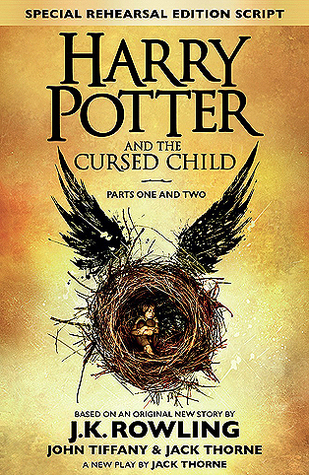
Few contemporary literary phenomena invite as fierce and persistent a blend of affection and suspicion as the continuation of a beloved series. Harry Potter and the Cursed Child is both an answer to that appetite and a provocation: not a conventional “next book” but a stage play whose text functions as a script, a dramatized sequel, and a piece of authorized fan-fiction all at once. Read as theatre, as commercial artefact, and as a late addition to the Potter corpus, it is a work that forces readers to ask what they want from a story when that story has already shaped them.
At the level of narrative, Cursed Child follows two parallel arcs: Harry Potter, now a weary Ministry employee and father, struggling with his public identity and private guilt; and Albus Severus Potter, his younger son, who inherits the narrative’s central anxiety—how to live inside the shadow of a famous parent. These personal strains are dramatized through a plot that leans heavily on time-twisting devices—echoes of the series’ earlier use of time-turners—and on the unlikely intimacy between Albus and Scorpius Malfoy. The play’s stakes are shaped less by the rescue of the wizarding world than by the rescue of individual relationships: friendship, filial love, and the possibility of forgiveness.
Evaluated as theatre, the play excels. John Tiffany’s staging (visible in the fruit of the original production) and Jack Thorne’s scene-craft make the script an engine for theatrical illusion—rapid scene changes, conjured creatures, and the physical choreography of time travel that theatre can render spectacularly. The text privileges beats and visual cues over long descriptive passages; as a result, the printed script can sometimes feel skeletal and flat. This is not a failure of imagination so much as an index of medium: the script was written to be seen. When imagined onstage, the play’s tempo and spectacle can reanimate lines that read oddly on the page.
But reading Cursed Child as a literary sequel raises tougher questions. The play’s greatest virtue is its psychological focus. Rather than extending the series’ epic struggle against an external evil, it internalizes the conflict: the trauma that legacy bequeaths, the ways stories and expectations can calcify identity. Albus and Scorpius become the emotional heart of the piece: their friendship is tender, funny and plausibly awkward in ways that feel earned. The play’s willingness to give the younger generation agency—sometimes better than the adults—provides a quietly subversive corrective to the cult of the Chosen One.
At the same time, the script often reads like a patchwork of old and new: familiar beats (time travel, alternate timelines, “what if?” permutations) are replayed with a heavier reliance on coincidence and theatrical contrivance. Critics and fans have complained—rightly, in my view—about certain retcons and character gestures that clash with the tone and psychology of the original novels. A number of adult characters, including Harry himself, are sketchier here: trauma has calcified into shorthand, and the complexities that informed Rowling’s earlier portrayals are sometimes flattened into melodramatic outbursts. The play asks us to accept rather than to be convinced.
Stylistically, the script bears the marks of collaborative authorship. Rowling’s mythic world and its lexicon are omnipresent—the familiar names and artifacts function almost as a shared language between text and audience—while Thorne’s dramaturgical instincts supply brisk dialogue and a succession of stage-ready moments. That synthesis yields lines that can be movingly plain or awkwardly expositional; the work’s dramatic architecture is often stronger than its rhetorical finish.
There is also an ethical and cultural reading to be made about Cursed Child’s existence. It negotiates the tension between authorial control and fan ownership. By choosing the theatre as medium—and by releasing the published script—Rowling and collaborators invited a broader public into a conversation about canonicity, theatrical adaptation, and the commodification of beloved texts. The play asks readers: when a world becomes shared property in the cultural imagination, who controls its future? The answer Cursed Child gives is pragmatic and ambivalent: the world can be extended, repurposed, and re-staged, but the result will not please everyone.
If the play has an abiding achievement, it is in its attention to parenthood and the quiet violence of legacy. The wound of being “the child of” reverberates across the play’s set pieces and quieter exchanges; the final act’s insistence on reconciliation—often earned through small acts rather than narrative pyrotechnics—feels sincere. Scorpius, in particular, emerges as one of the most sympathetically written figures in the extended saga: his decency complicates inherited villainy and offers the play a moral center.
In the end, Harry Potter and the Cursed Child is best judged on two levels simultaneously. As theatre it is often exhilarating: a dramaturgically ambitious, stage-hungry work that rewards performance. As a literary continuation it is provocatively uneven—full of humane observations and theatrical bravura, yet occasionally marred by convenience and an over-reliance on the aura of its predecessors. For readers who want their Potter as spectacle and emotional sequel, it will satisfy; for those seeking the novelistic depth and tonal continuity of the seven original volumes, it will feel like a different species of animal—one that must be assessed on its own terms.
Either way, the play reopens the conversation about what it means to inherit a story. In doing so, it reminds us that some legacies are not curses of fate but problems of love: how to live when your life has already been written into someone else’s legend. That is the question Cursed Child insists on, and for that alone the work is worth engaging with—onstage, and with a critical patience that the theatre itself invites.
Discover more from The New Renaissance Mindset
Subscribe to get the latest posts sent to your email.
 The New Renaissance Mindset