
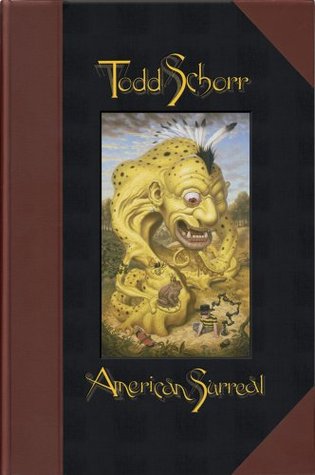
The lavish monograph published by Last Gasp and issued as the catalogue to a mid-career retrospective at the San Jose Museum of Art is more than a handsome picture book: it stages a sustained argument about how “low” imagery—cartoons, B-movies, advertising—can be retooled into a repository for moral satire, visual allegory, and painterly virtuosity. The volume gathers Schorr’s recent large-format canvases (the book’s scale itself performs a rhetorical amplification of its subject) and pairs them with curatorial perspective and close photographic detail; in short, it asks readers to slow down and read like critics rather than consumers.
Form and apprenticeship
One of the book’s most persuasive claims is formal: The artist, while steeped in cartoon vocabulary, pursues an Old-Master discipline. Critics and the catalogue repeatedly insist on this hybrid — “an abstracted cartoon vocabulary channeled through the techniques of the old masters” — and the reproductions in the book prove the point: tiny brushstrokes, glazed surfaces, and meticulously rendered textures produce a trompe-l’oeil finish that confounds easy categorization. This is not parody by sloppiness; it is parody by craft.
Narrative density and the Boschian inheritance.
Turn the pages and you enter paintings that operate like compressed moral comedies (or nightmares) à la Brueghel/Bosch, populated instead by Mickey-adjacent icons, rotten hamburgers, and anthropomorphic corporate mascots. A reviewer described Schorr’s scenes as resembling “an autopsy gone terribly wrong at Toontown General,” and that grotesque, clinical metaphor is apt: He dissects nostalgia and commerce with equal surgical glee—revealing seams, sutures, and the viscera of desire beneath the smiling veneers of mass culture. The book’s sequencing emphasizes this genealogical line—showing us how he translates the narrative crowds and moral parables of the Northern Renaissance into a twenty-first-century visual language.
Selected works as case studies
While the catalogue reproduces many paintings, a few act as anchor texts for this project. Works like When Fairy Tales Collide and The World We Live In (both represented in the retrospective and reproduced in the book) compress multiple registers—childhood wonder, carnivalesque violence, ecological and political anxiety—into single tableaux. Schorr’s devices are consistent: (1) a dizzying mise-en-scène in which foreground and background compete for narrative primacy; (2) accents of hyperreal detail (a cracked tooth, a glint on a soda can) that function as semantic fulcrums; and (3) a recurring child-figure or viewer surrogate who both anchors the composition and implicates the spectator in the scene’s moral confusion. These compositional choices are carefully documented with close-ups and process images in the book, which makes the catalogue useful not only to fans but to students of technique.
Tone and politics.
Schorr’s irony is double-edged. On one hand, there is affectionate nostalgia—his visual lexicon is a museum of American childhood objects—and on the other there is a savage moral eye that exposes complicity and decay. The book’s texts (curatorial essays and interview snippets) frame this dialectic: he does not merely lampoon consumer culture; he excavates the psychic sediment left by it. As a result, the humour often turns mordant—the pop-surreal smile becomes a grimace. The catalogue’s contextual apparatus (essays, exhibition chronology) helps the reader historicize the work within the so-called Lowbrow or Pop Surrealism movement without letting the movement’s label flatten the works’ ethical complexity.
Where the book could do more
As a museum catalogue and monograph, the book is strong on image reproduction and visual detail but less generous with long, sustained critical essays that place Schorr in a broader philosophical genealogy (e.g., psychoanalytic readings of nostalgia, or sustained visual theory about the cultural labor of caricature). A shorter, denser sequence of interpretive essays—panels of argument rather than curatorial orientation—would have pushed the volume from excellent catalogue to indispensable critical dossier. That said, the existing essays and the copious reproductions together invite close reading; the book’s restraint in theoretical expansion can also be read charitably as an invitation to the reader to do the heavy interpretive lifting.
Who will profit from this book
This catalogue will please collectors and general readers who want a spectacular object to leaf through, but it is also of genuine value to scholars interested in contemporary pictorial narrative, the afterlife of surrealist strategies in American pop culture, and craft-based resistance to the conceptualist consensus. For teaching, the book is a superb classroom tool: use a plate (or the paired close-ups) to teach iconography, or assign the curator’s essay alongside a historical text on Bosch or Dali to spark comparative readings.
American Surreal is a richly designed, visually intoxicating catalogue that confirms Todd Schorr’s centrality to contemporary Pop Surrealism: it is essential as a pictorial record and highly suggestive—if intermittently coy—about the larger critical claims those images could sustain under more sustained theoretical pressure.
Discover more from The New Renaissance Mindset
Subscribe to get the latest posts sent to your email.
 The New Renaissance Mindset