
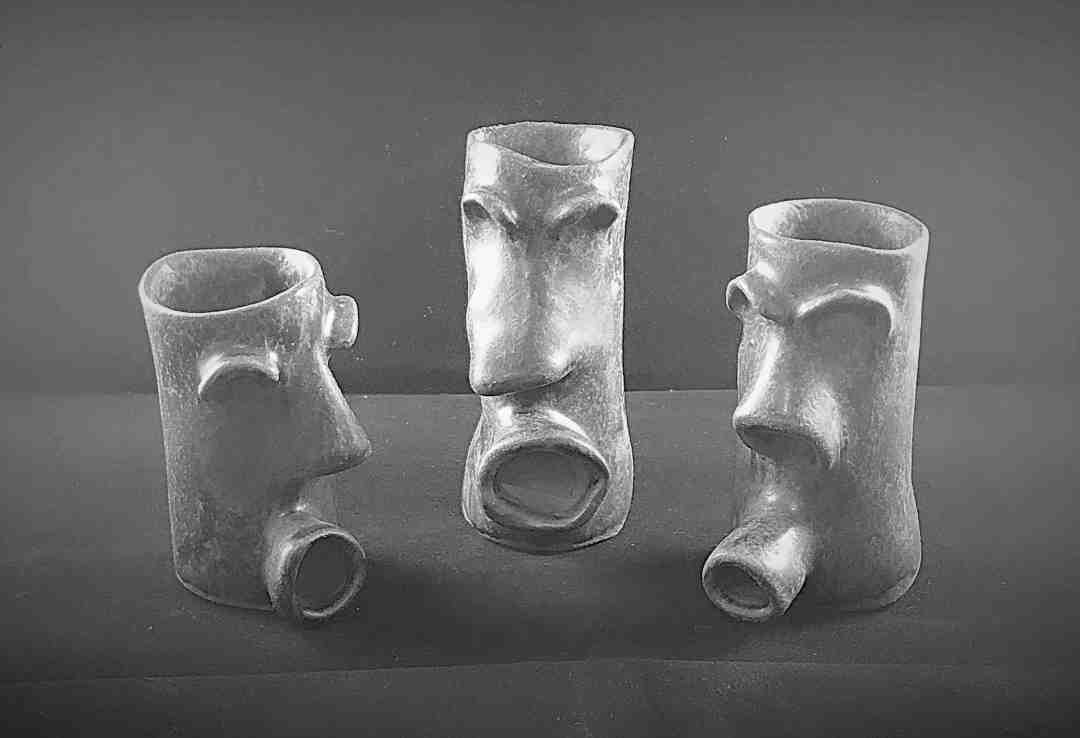
In the dim gallery a single bulb walks the floor.
Three sculptures lean together, elbows of stone touching,
a private parliament on a shared plinth.
Bronze clears its throat — a small metallic scrape —
and speaks first, hands like oars pointing outward:
“Borders are wounds,” it says. “We stitch them with paper
and call the stitch a treaty. It bleeds the same.”
Marble tilts its head, the slow law in its jaw:
“Names matter,” Marble replies. “Laws name the wound.
You can call a place a border, or a homeland —
the syllables decide who counts the dead.”
Terracotta — smaller, a child’s palm set into its side —
coughs clay dust and remembers:
“Someone put a child’s hand into me,” it says. “Not as art.
They pressed a palm that wanted bread. When I look, I keep
the hunger between my ribs. Do you think law feeds that?”
Bronze laughs, a bar of metal on a tongue:
“You want bread? Build a bakery out of ideals.
We have recipes: elections, sanctions, phrases.”
It jabs a chipped finger at a painted map on the plinth,
tracing a coast with the precision of a rusty compass.
Marble answers, carefully filing a corner of silence:
“Recipes need hands that can read them. Who teaches the farmer
to sign a contract? Who pays for the ledger? We forget
that paper needs the warm hands that make the bread.”
Terracotta presses its palm deeper into the plinth as if to hold the map down:
“Stop counting treaties and start counting children,” it says.
“My child’s palm is lighter than any declaration.
We forget the small, easy things: a clinic, a well, a warm bed.”
A pause. The gallery light hesitates, then moves on.
Outside, a bus unloads ten thousand untranslatable names.
Inside, the sculptures exchange a kind of geography.
Bronze: “If power is the engine, then we must sabotage it.”
Marble: “If power is the engine, we must inspect its bearings.”
Terracotta: “If power is the engine, we must feed the people stuck on it.”
They trade fragments like exiles: a coin pressed into a fold,
a tiny carved cot, an annotated list in low relief.
Patrons drift by, glancing at the labels — title, artist, price —
and miss the paragraphs being lived on the plinth.
“Buy me,” Bronze says mockingly to a passerby. “Or at least listen.
Purchase is not the only language of attention.”
Marble whispers the legalism of caution: “Patron, read the margins.”
Terracotta only asks for a hand to stay a moment longer.
Their conversation becomes proof: a treaty scored into a jaw,
a hospital’s ledger chipped into a knee, a nursery rhyme
inscribed across the base where dust collects like testimony.
“No single line will fix the map,” Bronze concedes, softer now.
“But if someone keeps carving, the map learns humility.”
Marble: “And if someone keeps arguing, the law will remember its duty.”
Terracotta: “And if someone keeps feeding, the small things become enough.”
Night watchman keys click like punctuation.
The bulb passes over them one last slow time;
the three statues fold their arguments into the dark,
not silent now but catalogued — a margin of the state.
If you press your palm to the plinth, the clay replies:
a child’s thumbprint, a ledger’s number, a rust-sweetened coin.
Art does not issue decrees; it keeps a light like a ledger
left open on a bedside table — a small proof for anyone who comes
to read more than the price.
Discover more from The New Renaissance Mindset
Subscribe to get the latest posts sent to your email.
 The New Renaissance Mindset