
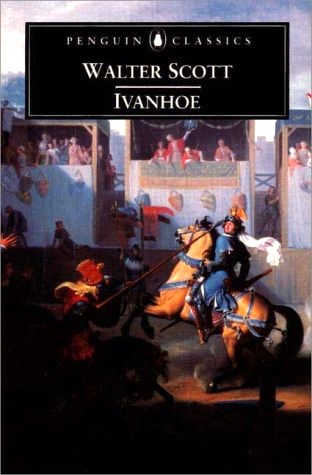
Ivanhoe is Walter Scott’s most famous excursion into English medievalism: part pageant, part moral romance, and part antiquarian essay. Its theatrical scenes (tilt-yards, sieges, trials by combat) sit beside pointed reflections on identity, religious prejudice, and the uneasy reconciliation of Saxon and Norman England. The book is at once intoxicatingly vivid and uneven — grand in spectacle, sometimes clumsy in plot — but its emotional and ideological friction is what keeps it alive for modern readers.
Narrative architecture & tone. Scott assembles Ivanhoe as a mosaic of genres: the knightly romance, adventure yarn, comic interlude (Wamba, the jester), and a proto-historical study. The narrator’s voice is characteristically Scotian — omniscient, often authorial, and inclined to antiquarian digressions that both enrich setting and occasionally interrupt momentum. This mixture produces a novel that reads like a staged medieval pageant narrated by a learned showman: sensory, decorative, occasionally moralizing. The book’s opening and the sequences around the Ashby tournament demonstrate Scott’s relish for spectacle and his habit of stepping back from the action to comment on its meaning.
Characters and moral center. At the heart of the novel is Wilfred (Ivanhoe) — the disinherited Saxon knight whose return from the Crusades drives the plot through disguise, tournament, and reconciliation. But the emotional intelligence of the book often rests on secondary figures:
- Rebecca emerges as the most compellingly modern figure: medically skilled, morally resolute, and dignified in the face of communal hostility. In a moment that Scott frames with almost clinical tenderness, he writes, “A moment of peril is often also a moment of open-hearted kindness and affection.” This sentence prefaces Rebecca tending Ivanhoe and signals how extreme circumstance reveals concealed humanity.
- Rowena represents the novel’s idealized woman — gracious, passive, the social prize around which claims and loyalties turn.
- Cedric, Bois-Guilbert, Locksley (Robin), Wamba — each registers different strains in the Anglo-Norman social fabric, from stubborn Saxon pride to Templar fanaticism to outlaw chivalry.
A striking passage that showcases Rebecca’s moral dignity occurs at the novel’s end when she identifies herself simply and proudly: “I am the unhappy Jewess…” (said to Rowena), a line that encapsulates both her alienation and her moral stature.
Themes: identity, tolerance, and the romance of the past. Scott stages England as a palimpsest of competing loyalties. The Norman/Saxon split serves as a vehicle for meditations on national identity: who belongs, who rules, and how law and custom enforce hierarchies. Religion and ethnic difference — especially the treatment of the other (Isaac and Rebecca) — form a moral tension: Scott is capable of deep sympathy toward Rebecca while still writing within a cultural milieu that sometimes reproduces period prejudice. The novel therefore invites two, often contradictory readings: as a plea for human sympathy across difference and as a text that reflects and sometimes fails to transcend its own era’s biases.
Style and rhetoric. Scott’s prose shifts between crisp descriptive sequences (battles, landscapes, the tiltyard) and rhetorical paragraphs that feel like mini-essays. That variability is part of the book’s charm but also its weakness: narrative forward motion can be interrupted by digression. Scott’s dialogue often aims at an “archaeological” pastiche of medieval speech; the effect can be vivid but occasionally rings artificial to modern ears.
Plot and dramaturgy. The novel’s episodes — the tournament at Ashby, the capture and siege of Torquilstone, the trial by combat for Rebecca — function like set pieces in a drama. Scott’s staging is masterly: tension is ratcheted through tightly described set pieces even when some plot contrivances (resurrections, timely arrivals, multiple reconciliations) strain credulity. Still, the episodic structure allows Scott to juxtapose scenes of cruelty and tenderness in ways that deepen the moral questions rather than merely provide spectacle.
Historical accuracy vs. imaginative use of the past. Scott was not aiming for modern historicism; he wanted to reawaken an enthusiasm for chivalric romance. Consequently, anachronisms and hybrid medievalisms appear (tournament customs, some legal procedures, and characterizations that mix centuries). Critics have long observed that Scott’s past is elastic — he borrows freely to create atmosphere and moral contrast rather than to write an exact chronicle. Readers should therefore approach Ivanhoe as imaginative medievalism rather than a documentary source.
Why it matters now. Ivanhoe did more than entertain: it shaped nineteenth- and twentieth-century ideas about the Middle Ages, Robin Hood, and the chivalric ideal. Its ambivalence about national identity and its humane portrayal of an outsider (Rebecca) still provoke useful conversations about empathy, otherness, and the responsibilities of historical imagination.
Shortcomings. The book’s moral ambivalence can feel under-resolved. Some characters are sketched more as types than as complex individuals; some episodes exist mainly to display Scott’s knowledge of medieval costume and custom. Modern readers may bristle at occasional stereotyping or at the narrative’s sentimental reconciliations.
Verdict. Read Ivanhoe for its theatrical passages, its memorable scenes (the Ashby tournament, the siege of Torquilstone, Rebecca’s farewell), and its capacity to make the past feel theatrically present. Read it critically — with an eye to Scott’s biases and to the ways he invents the Middle Ages to suit moral and national questions. For anyone interested in how nineteenth-century fiction shaped modern medievalism, Ivanhoe remains essential.
Discover more from The New Renaissance Mindset
Subscribe to get the latest posts sent to your email.
 The New Renaissance Mindset