
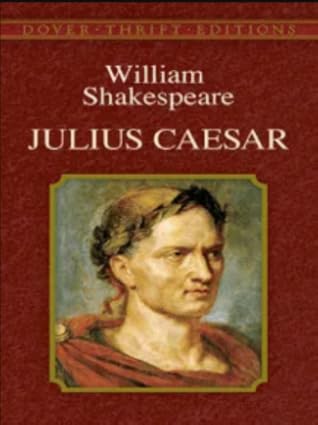
Shakespeare’s political tragedy is a compact, muscular probe into power, persuasion, and the moral costs of republican action. Read as a study of rhetoric and of the fragile psychology of honour, Julius Caesar refuses simple partisanship: it makes conspirators, orators, and crowds all culpable in a spiralling sequence whose logic is both inevitable and tragic.
On form and pace
The play is unusually tight. Rather than sprawling epic biography, this is a dramatist’s concentrated moral experiment: the assassination (Act 3) is the hinge; everything before it assembles motive and temperament, everything after it tests consequence. Its economy—short scenes, crisp transitions between public spectacles (senate, funeral) and private confession (tent, orchard)—keeps the moral questions in high relief. The rapid alternation of rhetoric and action makes persuasion itself a kind of weapon: speeches change allegiance, shape fate, and supply the play’s central dramaturgy.
Persuasion as technique and weapon
Persuasion is the play’s operating system. Consider how rhetoric works on multiple levels: political argument, private conscience, public spectacle. Cassius’s cynicism and Brutus’s honour produce different rhetorical registers. Cassius cajoles by psychological pressure—indeed, Cassius sees character as motive and manipulates it: “The fault, dear Brutus, is not in our stars” — a line that compresses political agency into moral responsibility. By contrast, Brutus appeals to a philosophy of civic virtue; his speeches invoke duty rather than malice, and it is precisely this appeal to honour that most persuasively binds conspirators to a course whose blindness will later be fatal.
The most famous counterexample is Mark Antony’s rhetorical virtuosity. Antony’s funeral speech—beginning with the deceptively simple “Friends, Romans, countrymen, lend me your ears” — converts private grief into public fury. Shakespeare stages rhetoric as alchemy: Antony’s measured sequence of irony, emotional exemplification, and repeated naming (“Brutus is an honorable man”) transmutes the crowd’s opinion and precipitates civil violence. The play thereby dramatizes how language can both found a republic and destroy it.
Character and moral ambiguity
Shakespeare fashions no single villain. Brutus is the play’s moral fulcrum: noble, reflective, self-deceiving. Brutus is sympathetic because his motive—fear of tyranny—reads as patriotic; yet his idealism becomes an instrument of catastrophe. The play’s tragic irony rests on Brutus’s error: that political murder, undertaken in the name of liberty, can secure liberty.
Cassius (first introduced as a calculating eye: “Yond Cassius has a lean and hungry look”) functions as antagonist and catalyst—hard-eyed, politically adept, adept at turning private resentment into public conspiracy. Cassius’s realism and Brutus’s idealism together produce the killing; the difference between them explains the aftermath. Meanwhile, Mark Antony, with his visceral speech and mastery of public affect, becomes the agent of popular retribution. Shakespeare thus refuses moral neatness: conspirators are not cartoon villains, and the avenger is not purely righteous.
Politics, crowd, and the modern resonance
The play’s interest in crowds and spectacle anticipates modern anxieties about propaganda, populism, and the theatricality of politics. The crowd in Julius Caesar is neither a moral actor nor a simple chorus; it is a mass whose judgment can be manufactured by performance. Antony’s manipulation shows how charismatic rhetoric and staged mourning can create consent. In an era when public opinion is manufactured as much by images and speeches as by argument, the play feels uncomfortably contemporary.
Language and imagery
Shakespeare balances classical allusion with immediate physicality. Omens and dreams—“Beware the ides of March”—sit beside blood and gore; the play repeatedly returns to bodily images (“bloody,” “bleeding piece of earth”) to remind us that political acts have physical consequences. The diction shifts depending on rhetorical aim: cool, legal diction for the conspirators’ justifications; colloquial, intimate cadences in Antony’s address; and prophetic, mythic language in the seer and Calpurnia’s warnings. This flexibility in register is one source of the play’s ongoing theatrical power.
A final note on tragedy without a single tragic hero
Unlike The Bard’s later tragedies which center more singularly on inner psychological unraveling, this one disperses its tragic energy across a small political community. The catastrophe is communal: motive, opportunity, and rhetoric all conspire. Caesar’s own stature—often present as an absent figure after his death—reminds us that the play is less about the fall of a man than the collapse of a polity. The chorus of culpability—conspirators, equivocating senators, a susceptible populace—makes the play a cautionary study in how republics can be lost by the very virtues meant to protect them.
Julius Caesar remains startlingly modern because it stages the mechanics of political persuasion, the fragility of civic virtue, and the unpredictable afterlife of violent remedies. Its compact structure, its genius for public speech, and its moral ambivalence make it indispensable for anyone who wants to understand how language and honour can together found—and undo—a political order. As a dramatic text it is lean; as a moral probe it is inexhaustible.
Discover more from The New Renaissance Mindset
Subscribe to get the latest posts sent to your email.
 The New Renaissance Mindset