
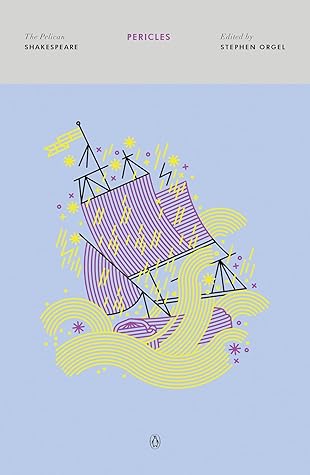
Pericles, Prince of Tyre is one of Shakespeare’s most unusual and affecting romances: a play that feels deliberately broken apart so that it can be mended before our eyes. Its power does not lie in dramatic polish or tight structure. It lies in motion—storm-tossed, fragmented, and miraculous motion—through loss, exile, silence, and recovery. What emerges is a drama less interested in worldly success than in the soul’s endurance under pressure.
From the opening, Shakespeare signals that this is a tale told through distance and mediation. Gower, speaking as a kind of medieval chorus, gives the play an old, ceremonial texture. His line, “To sing a song that old was sung,” establishes the mood at once: this is a story that comes to us as inheritance, memory, and legend. That framing matters. Pericles is not presented as a seamless realistic narrative but as a recovered ancient story, half-ruined by time and then reanimated by poetry. The play’s very form becomes part of its meaning.
The first great shock of the play is Antiochus’s court, where beauty is inseparable from corruption. The famous riddle scene is not merely a puzzle but a moral trap. Pericles begins as a prince seeking knowledge, but what he discovers is that power can make language itself diseased. Antiochus’s incest is hidden inside wit, inside ornament, inside courtly performance. Shakespeare turns speech into danger here: words conceal violence rather than reveal truth. The result is a world in which appearance is rotten at the core. Pericles’ swift flight from Antioch feels like an exile from moral contamination, not simply political threat.
From that point on, the sea becomes the play’s governing image. Shipwrecks, storms, separations, and delayed recognitions dominate the action, but they are never just incidents of adventure. The sea in Pericles is an agent of stripping and remaking. It destroys human plans, yet it also prevents the play from hardening into tragedy. Again and again, catastrophe interrupts certainty, and that interruption becomes merciful. The play seems to suggest that human beings must pass through chaos before they can deserve restoration. Suffering is not romanticized, but it is transformed into a condition of moral ripening.
This is especially clear in Pericles himself, who is perhaps one of Shakespeare’s most wounded fathers. He is not the commanding hero of the histories, nor the dazzling strategist of the tragedies. He is a man repeatedly reduced by grief. What makes him moving is not greatness in the conventional sense, but his vulnerability to loss. His silence after the apparent death of Thaisa is among the play’s most devastating gestures. Shakespeare understands that grief does not always speak; sometimes it numbs. Pericles is a figure of suspended mourning, and the play lets us feel the cost of that suspension over many years.
If Pericles embodies endurance, Marina embodies redemptive speech. She is one of Shakespeare’s most striking late heroines because she is defined not by conquest but by persuasion, integrity, and linguistic grace. In the brothel scenes, where corruption seems total, Marina becomes a figure of almost impossible purity. She does not defeat vice through force. She outlasts it through moral intelligence and verbal clarity. Her name itself suggests the sea, and therefore continuity with the play’s dominant element, but she also brings with her the promise that what has been scattered may still return. She is a child of peril and providence at once.
The reunion scenes at the end are where the play achieves its deepest emotional amplitude. Thaisa restored to life, Marina restored to her father, Pericles restored to speech and recognition: these moments do not simply tie up loose ends. They feel earned by suffering. Shakespeare does not make the ending neat; he makes it radiant. The play’s final emotional force lies in the fact that restoration arrives late, after numbness has settled in. In that sense, Pericles is about the miracle of return after almost-total ruin. Its joy is not innocent. It is experienced joy, joy that remembers grief.
As a literary work, Pericles is uneven, but that unevenness is part of its beauty. The play is stitched together from storms, riddles, voyages, and revelations, and the stitching is visible. Yet instead of weakening the drama, that visible fragility deepens it. It gives the play an almost human texture: broken, delayed, partial, and still capable of wholeness. Shakespeare seems less interested in perfection here than in providence, not in control but in survival. That is why Pericles lingers. It is a play about being battered by the world and still, somehow, arriving at grace.
Discover more from The New Renaissance Mindset
Subscribe to get the latest posts sent to your email.
 The New Renaissance Mindset