
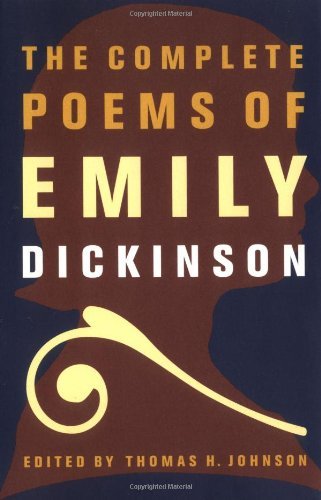
Emily Dickinson’s The Complete Poems is not merely a collection of verse but a literary cosmos, where the quotidian intersects with the metaphysical, and the intimate details of life are transformed into revelations of universal truths. This volume, encompassing Dickinson’s nearly 1,800 poems, allows readers to immerse themselves in the intricate workings of one of America’s most enigmatic and brilliant literary minds.
The Genius of Concision and Form
Dickinson’s genius lies in her economy of language. With a few well-placed words, she achieves what many poets fail to accomplish in lengthy stanzas. The brevity of her poems—often constructed in hymn-like quatrains—belies their density. Poems such as “Because I could not stop for Death” and “I dwell in Possibility” distill existential questions into crystalline verses. Her unconventional use of punctuation, particularly the dash, creates an ellipsis of thought, inviting readers to linger in the gaps between words. These pauses act as portals, leading us to meanings that hover just beyond articulation.
Themes of Mortality and Eternity
Mortality is a pervasive theme in Dickinson’s work, yet her treatment of it is far from morbid. In poems like “I heard a Fly buzz—when I died—,” Dickinson peers into the moment of death with clinical curiosity and spiritual yearning. Her exploration of eternity is both reverent and skeptical, as seen in “This World is not Conclusion.” Here, Dickinson balances faith with doubt, portraying the afterlife as an alluring yet inscrutable mystery. The result is a body of work that is both deeply spiritual and profoundly human.
The Interplay of Nature and the Inner Self
Dickinson’s keen observation of nature is not simply descriptive but deeply symbolic. Her poems transform humble creatures—bees, birds, and the “silver strife” of lightning—into metaphors for human experience. In “A Bird came down the Walk—,” the intricate behavior of a bird becomes a lens through which the poet contemplates the fragile balance between freedom and fear. This interplay between the external world and the inner self exemplifies Dickinson’s ability to turn nature into a mirror for the human condition.
Solitude and the Feminine Voice
Much has been written about Dickinson’s reclusive lifestyle, but to reduce her poetry to the biographical fact of her seclusion is to misunderstand her work. Her solitude was not a limitation but a crucible for her art. From the confines of her Amherst home, Dickinson cultivated a poetic voice that was simultaneously personal and universal. As a woman writing in the 19th century, she defied societal expectations, creating an oeuvre that has become a touchstone for feminist literary criticism. Her poems do not shout; they whisper, yet their echoes resonate across centuries.
The Modernity of Dickinson’s Vision
While firmly rooted in her 19th-century context, Dickinson’s work feels startlingly modern. Her willingness to embrace ambiguity and her rejection of conventional poetic forms place her alongside literary innovators like T.S. Eliot and Wallace Stevens. The fractured syntax and layered meanings of her verses prefigure modernist experimentation. Indeed, one might argue that Dickinson was not merely ahead of her time but outside of it altogether.
A World of Infinite Possibility
The Complete Poems of Emily Dickinson is not a book to be read but a world to be inhabited. It demands—and rewards—close reading, inviting us to grapple with questions of life, death, love, and eternity. Dickinson’s poetry is as much about the spaces between words as it is about the words themselves, as much about what is unsaid as what is said. For readers willing to accept her challenge, Dickinson offers not answers but possibilities, creating a dialogue that continues long after the final page is turned.
To enter Dickinson’s poetic world is to dwell, as she put it, in “Possibility—a fairer House than Prose.” It is a house with many rooms, each one revealing new and profound truths about the human condition. In this way, The Complete Poems is not merely a collection of poetry; it is an enduring testament to the power of the poetic imagination.
Discover more from The New Renaissance Mindset
Subscribe to get the latest posts sent to your email.
 The New Renaissance Mindset