
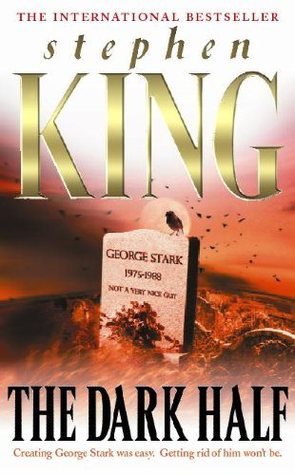
Stephen King’s The Dark Half (1989) occupies a distinctive place within his oeuvre, pairing his signature suspenseful narrative with incisive metafictional commentary. At once a chilling horror novel and a meditation on the nature of creation, identity, and authorship, it deftly explores what happens when an artist’s darker impulses—embodied here in a literal double—break free of authorial control. King, already renowned for his uncanny ability to tap into collective fears, turns the lens inward, examining his own duality as both creator and destroyer through the fate of his protagonist, Thad Beaumont.
Plot Overview
Thad Beaumont, author of the wildly successful (and gruesomely violent) novels penned under the pseudonym George Stark, has grown tired of writing sensationalist thrillers. When he publicly “kills off” Stark in an interview, complete with a staged funeral, the ruse takes on a horrific life of its own. Soon, Stark—materialized in the flesh—begins slaughtering those close to Beaumont in brutal, theatrical fashion. Thad must confront his own alter ego, discovering that to survive, he must reconcile the dark half of himself that he has long sought to suppress.
Themes and Symbolism
- Duality and the Shadow Self
At its core, The Dark Half is a modern Gothic fable of the doppelgänger. Drawing on Jungian psychology, King externalizes Thad’s repressed desires and anxieties in the form of George Stark. This personification invites readers to consider the inevitable interplay between creation and destruction within the artist’s psyche: to write violence is to flirt with it, and to deny one’s own darkness can have monstrous consequences. - Authorship and Responsibility
King grapples with the ethical dimensions of storytelling. Thad’s disdain for the sensationalism of his Stark novels mirrors the tension every writer faces when balancing commercial success with artistic integrity. The resurrection of Stark serves as a metaphoric reckoning: one cannot wholly disown what one has created. - Rural New England as Liminal Space
The novel’s setting—small-town Maine—becomes the perfect crucible for the uncanny. King’s evocative descriptions of mist-shrouded woods, abandoned cabins, and shadowed backroads underscore the permeability between the “real” world and the realm of imagination, where fiction spills over into violent reality.
Narrative Structure and Style
King employs a tight, third-person perspective that alternates between Thad’s rational, measured voice and the savage unpredictability of Stark. This shifting narrative accentuates the tension between order and chaos. His prose is economical yet vivid—each gruesome set piece is delivered with clinical precision, while quieter moments brim with an undercurrent of apprehension. Notably, King subverts genre expectations by embedding metafictional asides, reminding readers of the act of storytelling itself.
Character Analysis
- Thad Beaumont
Beaumont is one of King’s most introspective protagonists. A former creative writing professor, he embodies the conflicted artist, torn between the discipline of his “real” writing and the lurid appeal of his pseudonymous thrillers. King renders Thad’s fear, guilt, and reluctance with deep empathy, making his ultimate confrontation with Stark all the more affecting. - George Stark
As the personification of Thad’s suppressed impulses, Stark is pure id—ruthless, charismatic, and unapologetically violent. His very existence challenges the reader’s complicity in consuming violent fiction, forcing a confrontation with the darker corners of the imagination. - Supporting Cast
Characters such as Wilma, the Beaumonts’ housekeeper, and Sheriff Alan Pangborn (a recurring figure in King’s Maine universe) provide both practical aid and moral counterpoints. Their humanity and resilience underscore the broader stakes: the battle against one’s inner darkness is never fought alone.
Context and Influence
Published at the height of King’s popularity, The Dark Half owes much to earlier doppelgänger tales—Tolstoy’s The Double, Wilde’s The Portrait of Dorian Gray—while injecting fresh psychological urgency. Its metafictional self-awareness anticipates later works in which King would more overtly examine his role as creator, such as Misery (1987) and Bag of Bones (1998). The novel was adapted into a film by George A. Romero in 1993, attesting to its enduring intrigue.
The Dark Half stands as a powerful testament to Stephen King’s versatility and his acute understanding of the writer’s burden. Through the vivid clash between Thad Beaumont and his malignant other self, King not only delivers a visceral horror story but also offers a profound exploration of creativity’s double edge. For readers and writers alike, the novel serves as both cautionary tale and dark mirror, reflecting the peril—and necessity—of confronting one’s own shadow in order to prevail.
Discover more from The New Renaissance Mindset
Subscribe to get the latest posts sent to your email.
 The New Renaissance Mindset