
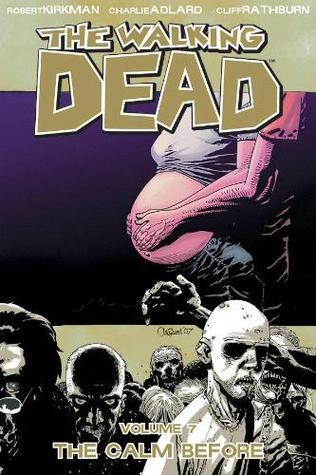
The Walking Dead, Vol. 7: Calm Before continues Robert Kirkman’s long interrogation of what it means to rebuild civilization after collapse. The volume tightens its focus on a single community attempting a return to ordinary life — festivals, social roles, children playing — and shows how fragile that ordinary life is. Kirkman balances moments of domestic tenderness and community ritual with the ever-present threat of the world outside the walls, driving the narrative toward a sudden, violent reversal that reframes everything the reader thought they’d understood about safety and moral order in this series.
Calm Before is quintessentially representative of what made The Walking Dead comics such an enduring conversation piece: it refuses the simple binaries of “safe” vs. “dangerous,” and substitutes instead an insistence that social constructs (festivals, committees, rituals) both sustain and betray the fragile subjectivities inside them. Where earlier volumes examine survival strategies in tactical or material terms, this volume is anthropological. It watches a fledgling polity attempt to re-pattern ordinary life — to make a calendar, to host a harvest fair, to teach children — and then dissects the political and ethical investments wrapped up in those attempts.
The title, Calm Before, works on more than one level. It names the outward stillness of a community rebuilding, but it also operates as dramatic irony: the calm is a mise en scène, a thin veneer covering unresolved tensions — between generational desire and intergenerational duty, between hunger for normalcy and the necessity of eternal vigilance. Kirkman stages this calm with painstaking care. Domestic scenes — conversations over food, ritualized games, the nervous bureaucracy of council meetings — are given space and dignity. That space, in the narrative economy, functions less as respite than as a pressure chamber: the reader senses that the very normalcy the characters crave will make the eventual rupture all the more devastating.
Formally, the volume excels in contrast. Kirkman’s plotting is patient, almost ceremonious, which amplifies the violence of his structural choices. He uses the mechanics of serial storytelling — extended build, character investment, and the hunger of serialization for meaning — to engineer genuine narrative risk. The catastrophic event that closes the volume is not mere spectacle. It is a narrative experiment in deferred catharsis: because we have watched these people make tables, hang lanterns, teach children to dance, the loss registers not only as physical death but as the obliteration of the labor and imagination that made community possible.
Art plays a central role in this work’s cruelty and tenderness. The stark black-and-white line art — rough, economical, frequently relegating background detail to suggestion — complements the text’s ethical austerity. Facial expressions are often minimal, which forces the reader to supply emotional texture; group compositions and negative space carry the weight of social dynamics. Silence — literal wordless panels — becomes a rhetorical device: quiet domestic panels read like prayers before catastrophe, and that silence is weaponized when it finally breaks. The visual pacing, from wide communal frames to claustrophobic close-ups, maps precisely onto Kirkman’s thematic oscillation between public ritual and private terror.
Thematically, Vol. 7 is preoccupied with rites: rites of inclusion and exclusion, rites of mourning and celebration, and the ritualistic mechanics of justice and revenge. The feast (or fair) sequence is particularly revealing. It is at once an attempt to reinstate pre-collapse ritual (a harvest festival, a carnival of sorts) and an experiment in political theatre: by publicly celebrating, the community performs its legitimacy and tests the bonds that hold it together. That performance is brutally exposed as insufficient; communal ritual cannot inoculate against random cruelty, and — perhaps more disquieting — it can be manipulated by actors who understand the performative limits of its protections.
There is also a sustained moral inquiry into leadership and responsibility. Rick and his cohort are not presented as heroic monoliths but as administrators of fragile compromises. The volume asks: what moral calculus is owed to strangers when the polity’s continued existence depends on tough, sometimes hidden choices? Kirkman refuses to offer a didactic answer; instead, he stages moral dilemmas and lets the psychic freight of those dilemmas fall where it may. This refusal to moralize is both the comic’s strength and its cruelty: readers are left to live in the same ambiguous ethical ecosystem as the characters.
Finally, the volume works as a meditation on grief and memory. The narrative’s closure forces the community to reckon with the limits of narrative continuity itself: the story they were telling about themselves — that they could reclaim ordinary life — is suddenly, brutally truncated. In literary terms, Kirkman converts serialized momentum into a technique of mourning; we do not simply register deaths as plot beats, but as wounds to narrative possibility.
Calm Before is one of the more daring and morally complex instalments in Kirkman’s series. It showcases his willingness to trade the safe pleasures of heroic resilience for a bleaker, more honest political psychology: communities are built in hope, but they are dismantled by both external violence and the internal contradictions of hope itself. For readers interested in how genre fiction can stage civic philosophy — how ritual, law, and mourning operate under duress — this volume is essential reading. It is also a difficult book emotionally: Kirkman gives no consolation prize, and his structural choices force the reader to live with the consequences of narrative risk.
Recommended for readers who appreciate serialized moral inquiry and for those who can tolerate a narrative that deliberately refuses balm. If you value character-driven world-building and an ethical imagination that interrogates rather than consoles, Calm Before delivers — insistently, uncomfortably, and with a bleak sort of grace.
Discover more from The New Renaissance Mindset
Subscribe to get the latest posts sent to your email.
 The New Renaissance Mindset