
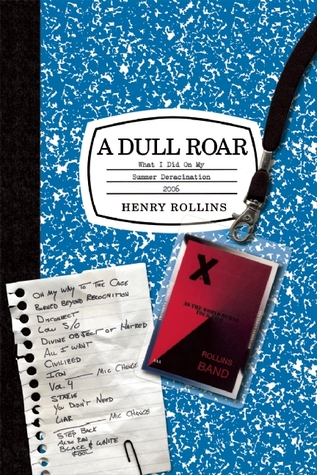
Henry Rollins has long worn many faces — punk provocateur, spoken-word performer, travel diarist, cultural gadfly — and A Dull Roar reads like the distilled audio of those public selves turned inward. The book insists on being heard: its sentences are kinetic, its cadence muscular, and its moral energy rarely sits idle. As a work of short prose, it trades the slow accrual of plot for a series of electric observations, confessions, and jolts of indignation that, taken together, make a shape both ragged and oddly deliberate.
At the level of craft, Rollins’s prose is tense and immediate. He favours clipped declaratives and abrupt analogies; metaphors ricochet rather than settle. That terseness is not always austerity — there is a rhetorical generosity to the book’s outbursts, a willingness to linger on embarrassment, doubt, and small mercies. The result is a voice that feels performative and private at once: the voice of a man used to addressing crowds who nevertheless refuses the easy shelter of anonymity. This tension — between exhibitionism and intimacy — becomes the book’s real subject.
Themes recur like drumbeats. There is rage, certainly: a righteous, historically informed anger toward cruelty, hypocrisy, and complacency. But rather than spectacle, Rollins often channels anger into moral inventory-taking. He writes about failure and stubbornness, about the landscapes of solitude (hotel rooms, late-night drives, the backstage liminality of tour life), and about the corrosive and occasionally redemptive effects of memory. Time in these pages is not only chronological but tactile; it has the weight of a slammed motel door and the echo of an audience dissipating. The titular “dull roar” is less a literal sound than a persistent hum of existential unease — the background noise of modern life that the author refuses to ignore.
One of the book’s quieter gifts is its humane curiosity. The authors’s interlocutors — strangers he meets on the road, the shadow-people of his past, the younger self who keeps reappearing in lesser decisions — are treated with a surprising sympathy. This compassion complicates his brashness; it converts bluster into moral inquiry. When he interrogates masculinity, fame, and the ethics of attention, it’s not merely to perform a stance but to examine the scaffolding beneath it. The scenes where tenderness intrudes — in caregiving, in grief, in the awkwardness of apology — are some of the most persuasive moments in the book precisely because they feel precarious and earned.
Formally, A Dull Roar is in conversation with the tradition of the essay as personal performance. It borrows the rhythm of a spoken-word set — peaks and troughs, repeated refrains, abrupt returns — and transposes that energy to the page. This hybrid of orality and composition is often exhilarating, though it can also be uneven: certain pieces resolve with crystal clarity, while others break off mid-thought as if the performer were already scanning the room for the next cue. That unevenness can be affecting; it is honest to the impulses that produce the work. At the same time, readers who prefer sustained narrative or systematic argument may find the episodic architecture frustrating.
The book’s larger cultural project is worth noting. Rollins resists cynicism as an aesthetic posture; he treats moral engagement as a craft. In an era when outrage is often performative, his insistence on prolonged engagement — sometimes messy, often unglamorous — reads like an argument for ethical stamina. Whether examining small-town cruelty or personal lapses, he seems to ask: what do we owe one another when our attention is the only real currency?
If the book has a limit, it is occasionally its tendency to valourize endurance without fully interrogating the structures that make endurance necessary. The author’s moral rigour is admirable, but some essays risk framing personal resilience as a sufficient response to systemic problems. Still, this is a minor quarrel in a book whose strongest moments are both lucid and piercing.
In short, A Dull Roar is not a comfort read, nor does it aim to be. It’s an insistently honest collection that channels performance energy into reflective force. Readers drawn to confessional essays, to prose that wants to be spoken aloud as much as read, will find much to admire. Those seeking tidy conclusions will have to be satisfied with provocation and the lingering sense that the real work — of listening, of changing — begins after the last line.
Discover more from The New Renaissance Mindset
Subscribe to get the latest posts sent to your email.
 The New Renaissance Mindset