
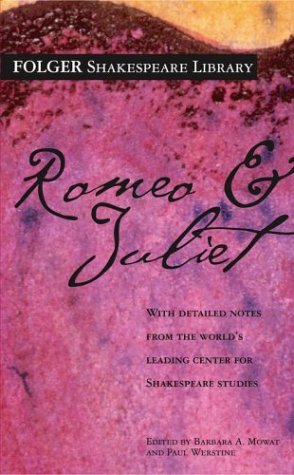
Shakespeare’s work here reads like a distilled drama of human contradiction: love and violence, chance and design, speech that soars and action that wounds. This play—set in Verona—remains instructive not because it tells us something entirely new about passion, but because it shows, with rare intensity and compression, how quickly language can conjure a world and how quickly that world can implode.
Summary in a line
The Prologue announces the engine of the play: “A pair of star-cross’d lovers take their life.” That sonnet-shaped preface (the play opens with a tightly controlled fourteen-line octave) both frames and haunts the action: we watch not to learn the ending, but to see how fate, temperament, and social structures conspire to produce it.
Language and form — poetry that performs
Shakespeare’s craft is musical and tactical. The play opens with a public quarrel rendered in brisk prose and puns; by contrast, the lovers’ first meeting and their balcony exchange are saturated in lyric and conceit. Romeo’s awakening rhetorical question—“But, soft! what light through yonder window breaks?”—turns natural observation into mythic metaphor: Juliet becomes not merely beloved but cosmology. Likewise, the lovers’ declaration — “What’s in a name? That which we call a rose / By any other name would smell as sweet” — distills the play’s central philosophical provocation about social labels and authentic feeling. The alternation of sonnet, blank verse, and charged prose allows Shakespeare to mark register (public vs private, comic vs tragic) while keeping emotional momentum taut.
Character and psychology — more than adolescent ardor
Critical readings sometimes reduce Romeo and Juliet to “teenage love,” but the play stages conflicting kinds of agency: Romeo’s impulsive, rhetorical subjectivity; Juliet’s accelerating practical intelligence; Mercutio’s mock-heroic bravado; and Friar Lawrence’s well-intentioned but dangerously experimental moralism. Consider Mercutio’s famous quip—“a plague o’ both your houses”—a terse, prophetic indictment that crystallizes the social toxicity fuelling the personal catastrophe. Juliet’s rapid ethical growth (from obedient daughter to conspirator in a deception with cosmic consequences) makes her less a passive object than a decisive actor whose choices are morally fraught rather than simply romantic.
Dramatic architecture and the mechanics of tragedy
The Bard composes tragedy as a temporal squeeze: acts move quickly, coincidences accumulate, and the rhetoric of fate is constant. The “violent delights” warning—“These violent delights have violent ends”—serves as verbal foreshadowing and moral paradox: the intensity that elevates becomes the intensity that destroys. The structure converts social enmity into private catastrophe; every duel, joke, and whispered plan tightens the narrative noose. The play’s economy—its compressed timeline and rapid reversals—makes the catastrophe feel inevitable and avoidable at the same time, producing the moral ambiguity that keeps readers and audiences returning.
Social context and politics — households, honour, and performative masculinity
At base the tragedy pivots on more than romantic folly: it is an indictment of a culture in which honour is publicly performed and feud is a social institution. The Capulet–Montague conflict is not merely backdrop; it is a system that rewards aggression and ritualizes retaliation. The public brawls, the pressure on male characters to prove themselves, and the marginal voices (the Nurse, the Apothecary) together show a civic order that leaves intimate life vulnerable to political logic.
Staging and interpretive possibilities
Part of the play’s power is theatrical: its most famous scenes—the masquerade, the balcony, the tomb—are visually and performatively potent, inviting endless reinterpretation. Directors can emphasize the political or the personal, the comic or the horrific, because the text so richly supports multiple emphases. The Prologue’s sonnet, the lovers’ sonorous speech, and Mercutio’s barbed wit provide levers for tone: shift one, and the play tilts from lyric romance to dark satire.
Enduring questions and modern resonance
Why does this 16th–17th-century work still crackle? Because it stages the precariousness of desire inside social constraint and because its language keeps renewing itself in performance. Lines like “Thus with a kiss I die” gain force not only from their words but from the economy of meaning that Shakespeare has already built. The play forces us to ask how communities permit or prevent reconciliation, and how language that once elevated love can, in a matter of scenes, be implicated in ruin.
Worth reading and seeing, repeatedly
Romeo and Juliet is more than a teenage romance; it is a tightly wound moral and theatrical experiment in how passion and polity intersect. Read it for the stunning lyric moments, watch it for the theatrical risk, and study it for the way Shakespeare compresses human contradiction into a few blazing acts. The play’s brilliance lies not in answering the questions it raises but in staging them so memorably that they continue to trouble and instruct readers and audiences across centuries.
Discover more from The New Renaissance Mindset
Subscribe to get the latest posts sent to your email.
 The New Renaissance Mindset