
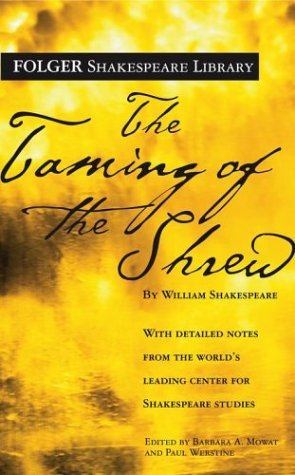
The Taming of the Shrew is one of those plays that refuses the neat categories critics try to pin on it: at once a farce, a satire of social performance, and an uncomfortable meditation on marriage and power. The play’s comic machinery is brilliant — quick-paced plotting, disguise and mistaken identity, witty repartee — but that brilliance sits uneasily beside scenes that, to modern eyes, register as coercive and even violent. A careful reading must hold both facts in tension: admire the craftsmanship while refusing simple moral excusal.
Form and frame
The play opens with an Induction that frames the main action as a theatrical trick played on the rustic Christopher Sly. That frame makes the piece self-conscious about theatre itself: the entire social world of Padua is staged for Sly’s amusement, and the “taming” we watch is thereby presented as performance — a performance for an audience within the play and for us. That metatheacricality is not a neutral ornament; it destabilizes any straightforward reading of the main plot by constantly reminding us that identity, obedience, and rage can be performed and rehearsed.
Language and character
The play’s energy lives in its language. Petruchio’s swaggering lines — “I come to wive it wealthily in Padua; / If wealthily, then happily in Padua” — announce courtship as economic project as much as emotional one, and they foreground the transactional logic that underlies many of the play’s couplings. At the same time Kate’s barbed retorts—“If I be waspish, best beware my sting”—reveal a speaker who is verbally lethal and unwilling to perform the docility expected of her. These short, striking utterances illustrate how Shakespeare equips both lovers and antagonists with a rhetorical arsenal; the jokes cut, and the comic violence is often linguistic before it is physical.
The “taming” itself. The central sequence — Petruchio’s deliberate withholding of food, sleep, and social comforts, and his theatrical inversion of social expectation — is among Shakespeare’s most ambiguous set-pieces. Read as a triumphant comic reversal, Petruchio’s tactics may be interpreted as the restoration of social order (the play wants its marriages to “work”). Read otherwise, they look like a campaign of domination staged as education. Crucially, the play leaves room for divergent responses: some critics hear Kate’s final public speech as evidence of sincere conversion; others (and the performance history of the past century shows this plainly) stage it as ironic, strategic, or coerced. The text resists a single hermeneutic.
Katherine’s final speech and the wager scene force the issue. The climactic exchange in Act V — a contest among husbands over which wife will most obey — culminates in Kate’s long address on wifely duty. That speech functions dramatically as the play’s resolution, and yet its meaning is slippery: is it an authentic capitulation, a parodic imitation of patriarchal rhetoric, or a tactical performance that secures safety within a patriarchal economy? Because the speech sits at the intersection of performance, gender, and economic necessity, any responsible reading must allow for the possibility that its surface sense (“submission”) and its performative implications diverge.
Staging and ethical reading
Contemporary productions typically choose one of two routes: expose the violence and problematize Petruchio’s “taming,” or find ways to reframe the ending as mutual reconciliation (often by softening Petruchio and emphasizing Kate’s agency). Both approaches are legitimate interpretive moves, and the play’s textual openness invites them. Practically speaking, directors who wish to retain the play’s comic momentum while avoiding endorsement of coercion must attend closely to tone, pace, and the choreographic detail of Petruchio’s “tyrannies.” The Induction — which can be staged as a cruel joke or as an ironic commentary on social performance — will largely determine whether the audience reads the main plot as satire or as social prescription.
Why the play still matters
It is tempting to bracket the play as a historical curiosity: obviously “of its time,” and therefore safely unreadable as a model for present conduct. But that would miss its provocation. The play forces us to examine how social roles are learned, rehearsed, and policed. It interrogates rhetoric itself — who gets to speak, who is permitted silence, who is rewarded for wit — and it stages the relation between economic interest and affective claim. For readers and audiences today, the play offers an opportunity to interrogate the gendered assumptions of both past and present and to reflect on how comedy can both expose and reproduce injustice.
Discover more from The New Renaissance Mindset
Subscribe to get the latest posts sent to your email.
 The New Renaissance Mindset